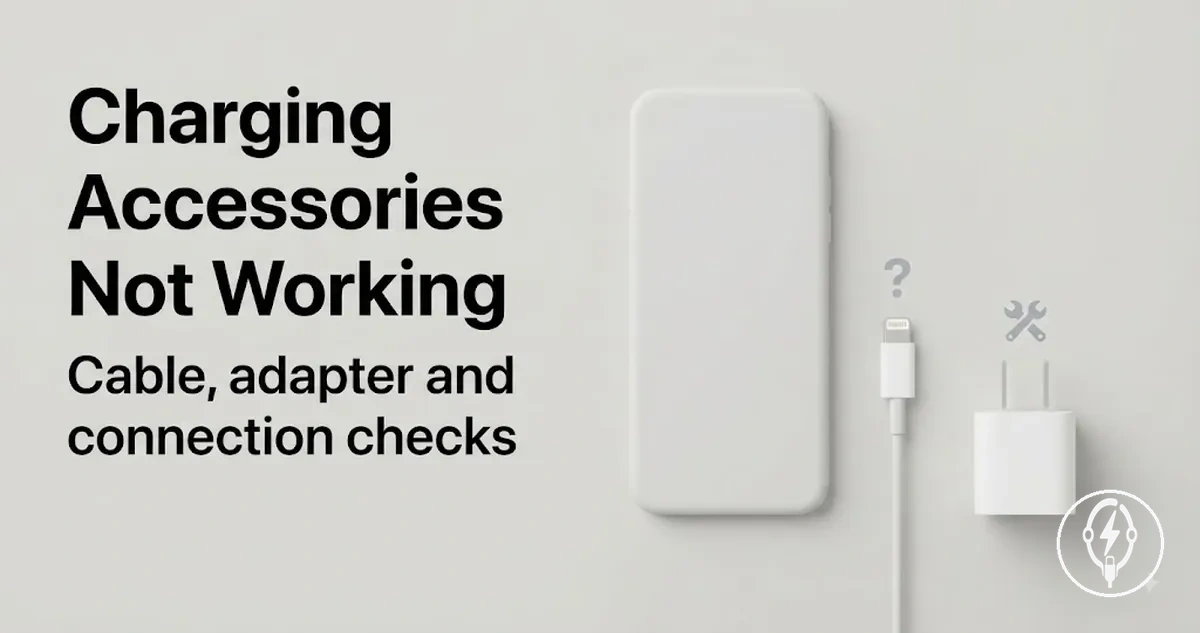
iPhone Charging Accessories Not Working
iPhone charging accessories can stop charging because the fault is with the accessory, the connection, the power source, or the iPhone itself rather than a single component. According to Apple Support, a safe diagnosis starts by separating accessory-side issues, such as a damaged charging cable, charging adapter, or wireless charger, from possible iPhone-side issues, including the charging port or software. This page focuses on identifying that accessory-versus-phone boundary before moving into specific troubleshooting steps.
This page focuses on identifying that accessory-versus-phone boundary before moving into specific troubleshooting steps.
Most charging problems become easier to diagnose after observing the symptom rather than replacing accessories immediately. Apple Support recommends checking for visible damage to the charging cable or adapter, confirming that the power outlet supplies power, inspecting the iPhone charging port for debris, and testing with another compatible charging accessory when available. If the charging problem follows one accessory across multiple compatible devices, the accessory is the more likely cause; if multiple known-working accessories fail with the same iPhone, the phone-side charging system should also be considered.
Most charging problems become easier to diagnose after observing the symptom rather than replacing accessories immediately.
The safest diagnostic approach is to test one part of the charging setup at a time while keeping the remaining components unchanged. For example, replacing only the charging cable while keeping the same charging adapter, power source, and iPhone allows you to observe whether intermittent charging, slow charging, or not charging changes with a single variable. Apple Support identifies this step-by-step isolation process as a practical way to distinguish charging accessory failure from an iPhone-related charging issue because the underlying cause depends on the accessory condition, iPhone model, charging method, and operating environment.
The safest diagnostic approach is to test one part of the charging setup at a time while keeping the remaining components unchanged.
The following sections organise the most common symptoms, likely causes, safe checks, and replacement cues for iPhone charging accessories so you can narrow the problem before deciding whether the accessory or the iPhone requires further attention.
Table of Contents
Charging Accessory Problem or iPhone Charging Problem
A charging accessory problem is more likely when the same cable, adapter, wireless charger, or power source fails across more than one compatible device, whereas an iPhone charging problem is more likely when multiple known-working charging accessories fail with the same iPhone. According to Apple Support, comparing the charging result with another compatible accessory under the same conditions is the safest initial way to distinguish an accessory-side fault from a possible phone-side issue without assuming a hardware failure. This distinction separates likely accessory-related causes from possible iPhone charging causes before further troubleshooting.
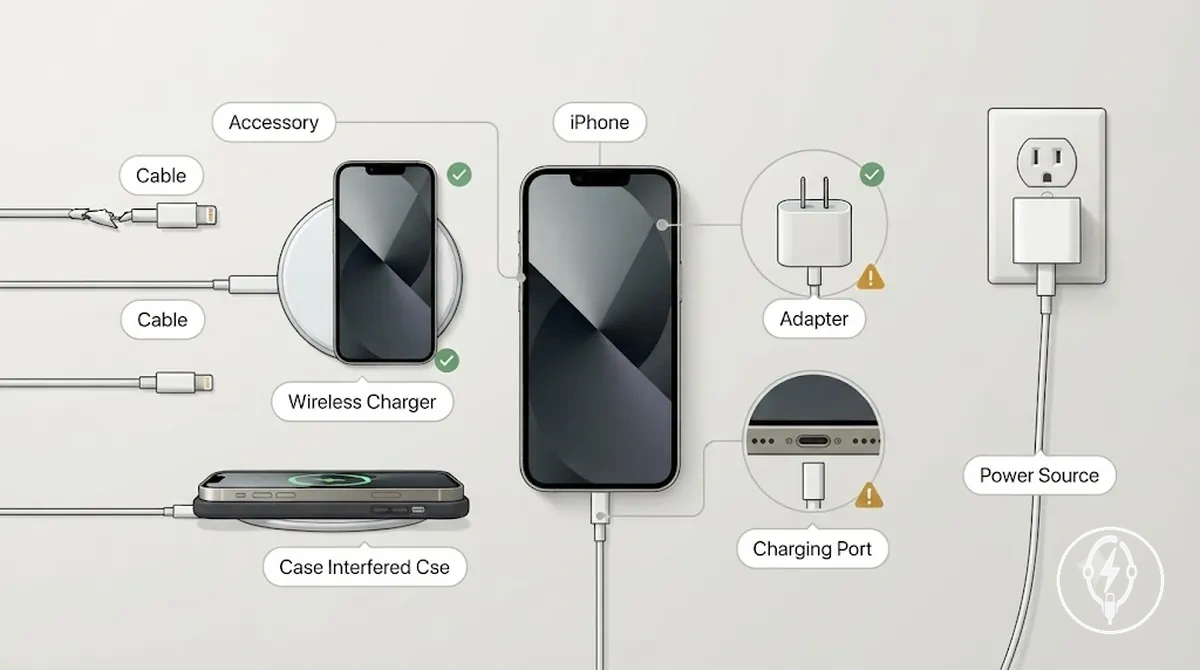
iPhone charging accessories include the charging cable, charging adapter, wireless charger, and compatible charging components that deliver power to an iPhone. According to Apple Support, damaged cables, faulty adapters, an inactive power source, debris causing poor contact in the charging port, wireless charger misalignment, or case interference can each interrupt charging even when the iPhone itself remains functional. For example, if one charging cable fails on two compatible devices while another cable charges both devices normally, the observed symptom is more consistent with a charging accessory problem than an iPhone charging problem. This overview intentionally separates those conditions from detailed compatibility, cable-type selection, and charging-port cleaning guidance.
This overview intentionally separates those conditions from detailed compatibility, cable-type selection, and charging-port cleaning guidance.
The comparison below summarises the most common observations that help distinguish an accessory-side issue from a possible phone-side issue before moving to detailed diagnostics.
| Observed condition | Likely implication |
|---|---|
| The same cable or charging adapter fails with two compatible devices | Charging accessory problem involving the cable, adapter, or connector |
| Multiple known-working charging accessories fail with one iPhone | Possible iPhone charging problem involving the charging port, software state, or charging hardware |
| Wireless charging starts only after removing a thick case or improving alignment | Case interference or wireless charger alignment causing charging interruption |
| Charging resumes after changing to another wall outlet or USB power source | Power source issue rather than an accessory or iPhone fault |
Symptoms That Point to Charging Accessory Failure
Charging accessory failure is more likely when the same charging symptoms consistently occur with one cable, charging adapter, wireless charger, or power source but disappear after replacing that accessory with a known-working compatible one. According to Apple Support, symptoms such as no charging response, slow charging, repeated disconnecting, warning messages, heat, and wireless interruption are diagnostic indicators that should prompt accessory checks rather than being treated as proof of accessory failure. The key diagnostic condition is whether the symptom follows the accessory instead of remaining with the iPhone.
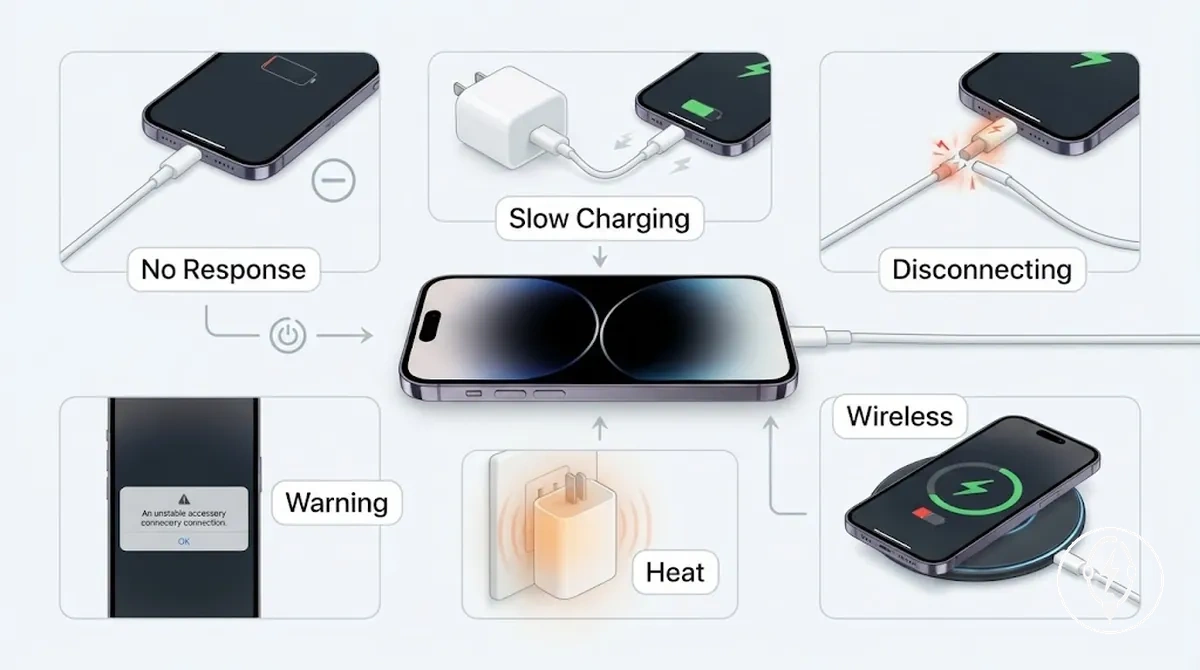
These charging symptoms help determine whether a charging accessory is the most likely source of the problem before investigating specific causes. For example, if one Lightning or USB-C cable repeatedly disconnects while a second compatible cable charges the same iPhone normally under identical conditions, the charging behaviour is more consistent with an accessory-side issue than an iPhone hardware fault, as recommended by Apple Support's charging troubleshooting guidance.
- No charging response: The iPhone shows no charging indicator after connecting a charging cable or placing it on a wireless charger. Possible accessory-side causes include a damaged cable, faulty charging adapter, inactive power outlet, or poor connector contact. The next check is to test a different compatible accessory using the same iPhone.
- Slow charging: Charging begins but progresses noticeably slower than expected. According to Apple Support, reduced charging speed can result from a low-power USB source, a damaged charging cable, or an incompatible power adapter rather than an iPhone battery problem. The next signal is whether charging speed returns to normal after changing the accessory.
- Disconnecting: Charging repeatedly starts and stops without moving the device. This charging behaviour commonly indicates an intermittent cable connection, worn connector, or unstable charging adapter contact. Testing another compatible cable helps determine whether the symptom follows the accessory.
- Warning message: Messages such as "This Accessory May Not Be Supported" or "Liquid Detected in Connector" can indicate a contact issue, contamination, incompatible hardware, or an unstable accessory connection. Apple Support recommends disconnecting the accessory, checking the connector and charging port, and allowing moisture to dry before reconnecting if liquid detection appears.
- Heat: A charging cable, adapter, or wireless charger becoming unusually warm together with charging interruptions can indicate an accessory fault or poor electrical contact. If excessive heat accompanies repeated charging failures, discontinue use until the accessory has been inspected.
- Wireless interruption: Wireless charging repeatedly starts and stops until the iPhone is repositioned. Possible accessory-side conditions include charging pad misalignment, case interference, or a faulty wireless charger. Confirm the symptom by removing thick cases and testing another compatible charging pad.
No Charging Response When Plugged In
A no charging response when plugged in occurs when an iPhone shows no charge indicator after being connected to a charging cable and power source. According to Apple Support, this symptom most commonly indicates that power is not reaching the iPhone because of cable contact, adapter output, outlet power, connector seating, or visible accessory damage, although a deeply discharged battery can also delay the charging indicator for several minutes. The main diagnostic condition is whether the charge indicator appears after testing a known-working compatible charging accessory.
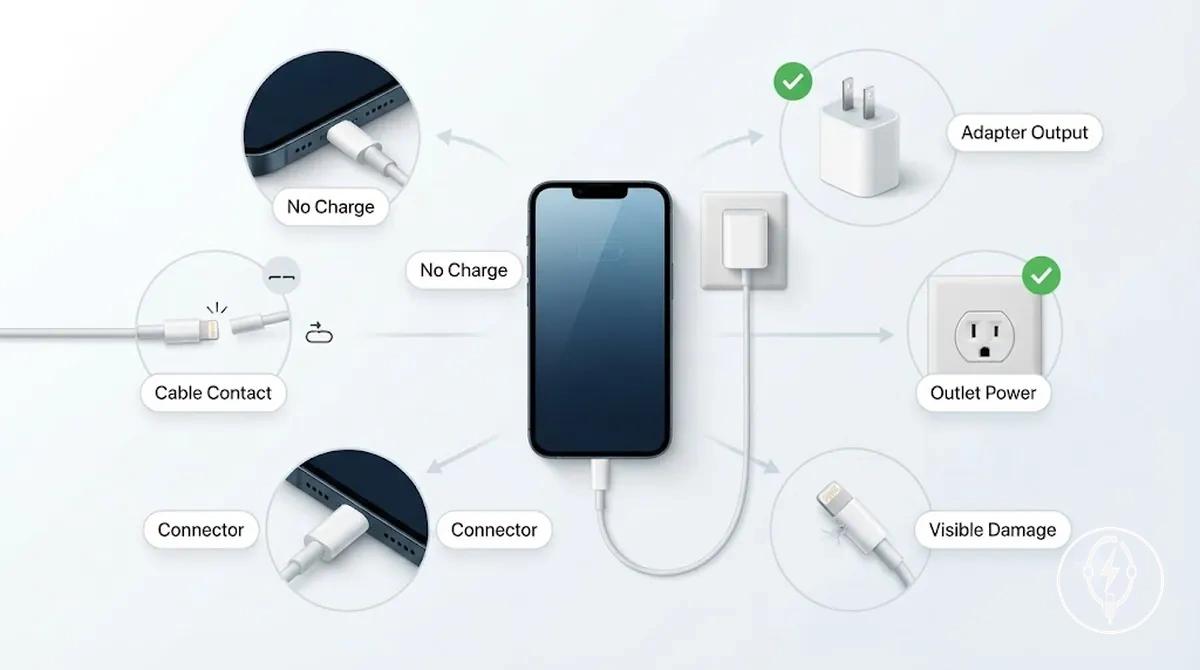
The checks below help isolate whether the no charging response is caused by the charging accessory or its power path before considering less common causes. For example, if one cable produces no charge indicator but a second compatible cable immediately starts charging using the same adapter and outlet, the symptom follows the accessory rather than the iPhone, consistent with Apple's charging troubleshooting guidance.
- Cable contact: Ensure both ends of the charging cable are fully inserted and remain secure when lightly moved. Loose cable contact can prevent electrical continuity and result in no charging response.
- Adapter output: According to Apple Support, test the cable with another compatible USB power adapter. If charging begins with the replacement adapter, the original adapter is not providing usable output.
- Outlet power: Verify the wall outlet or USB power source by connecting another working electrical device or charger. An inactive outlet prevents the iPhone from displaying the charge indicator regardless of cable condition.
- Connector seating: Check that the connector is fully seated in the charging port and inspect the port for lint or debris that could interrupt contact. Apple Support recommends cleaning only with a non-metallic tool and avoiding force that could damage the connector.
- Visible damage: Inspect the charging cable and adapter for frayed insulation, bent connector pins, cracked housings, or exposed wires. Apple Support identifies visible physical damage as a common reason a charging accessory fails to deliver power safely.
Slow Charging or Slow Charger Warnings
Slow charging or a slow charger warning means the iPhone is charging but receiving power at a lower rate than it can under the current conditions. According to Apple Support, iOS 18 and later can display a Slow Charger notification when the connected charger provides less power than the iPhone can use for faster charging, although the warning alone does not confirm a faulty accessory. The main diagnostic condition is whether charging speed improves after changing only the charging accessory or power source.
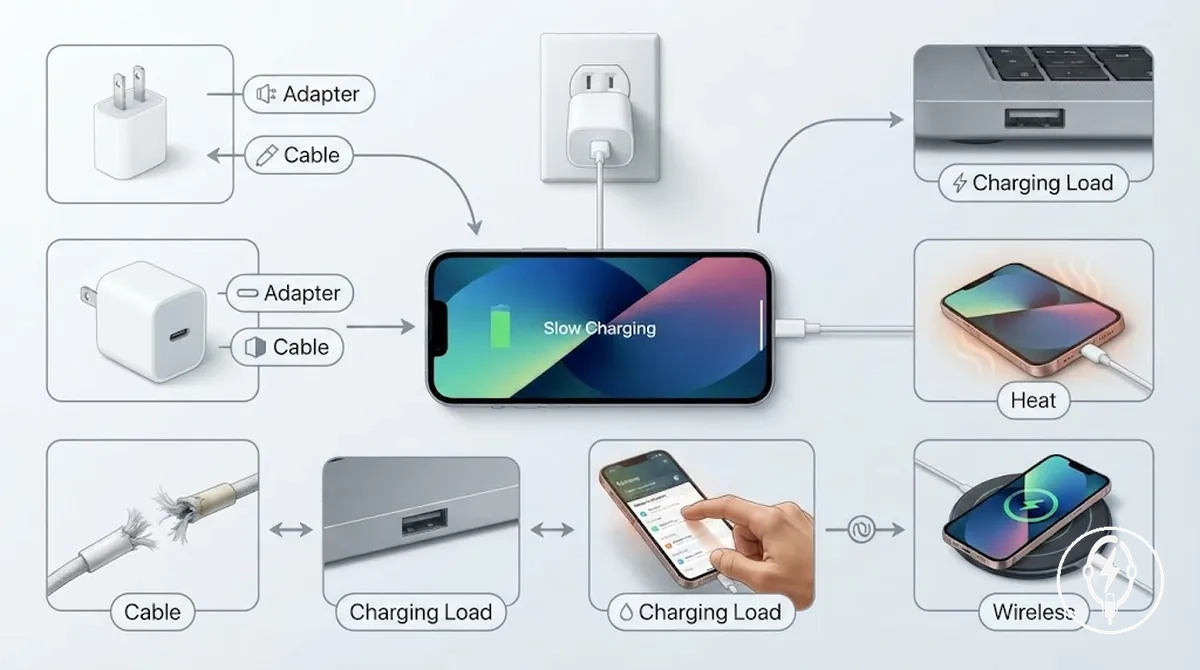
The checks below help determine whether slow charging is caused by accessory limitations, operating conditions, or normal charging management rather than immediate accessory failure. If you need to compare this symptom with expected charging behaviour, see slow fast charging issues after testing the same iPhone with a compatible higher-power charging setup under similar conditions. For example, Apple states that an iPhone connected to a 5 W USB power adapter will normally charge more slowly than the same iPhone connected to a compatible 20 W USB-C power adapter, assuming battery temperature and device usage remain similar.
- Adapter wattage: According to Apple Support, a 5 W or other lower-output USB power adapter delivers less charging power than a compatible 20 W or higher USB-C power adapter, resulting in slower charging under comparable conditions.
- Cable capability: A damaged, worn, or limited-capability charging cable can reduce available power or trigger a slow charger warning even when the power adapter supports higher output. Testing with a known-working compatible cable helps isolate the cable from the adapter.
- Power source quality: Charging from a low-power USB port on older computers or accessories may provide less power than a wall power adapter, increasing charging time even when the cable is functional.
- Heat: Apple specifies that iPhone automatically reduces charging speed when battery temperature becomes elevated to help protect battery health. Charging normally resumes at a higher rate after the device cools.
- Charging load: Running navigation, gaming, video recording, or other high-power tasks while charging increases power consumption, reducing the net amount of energy available to recharge the battery.
- Wireless efficiency: According to Apple Support, wireless charging is generally less power-efficient than a direct wired connection, and poor charger alignment or a thick protective case can further reduce charging speed or trigger intermittent charging.
Charging Connects and Disconnects Repeatedly
Charging that repeatedly connects and disconnects is usually a symptom of intermittent charging caused by unstable electrical contact or inconsistent power delivery rather than confirmation of an iPhone hardware fault. According to Apple Support, repeated charging interruptions commonly originate from an unstable charging cable, connector, power adapter, charging contacts, or power source, and the main diagnostic condition is whether the charging interruption changes when the cable is held still or replaced with a known-working compatible accessory.
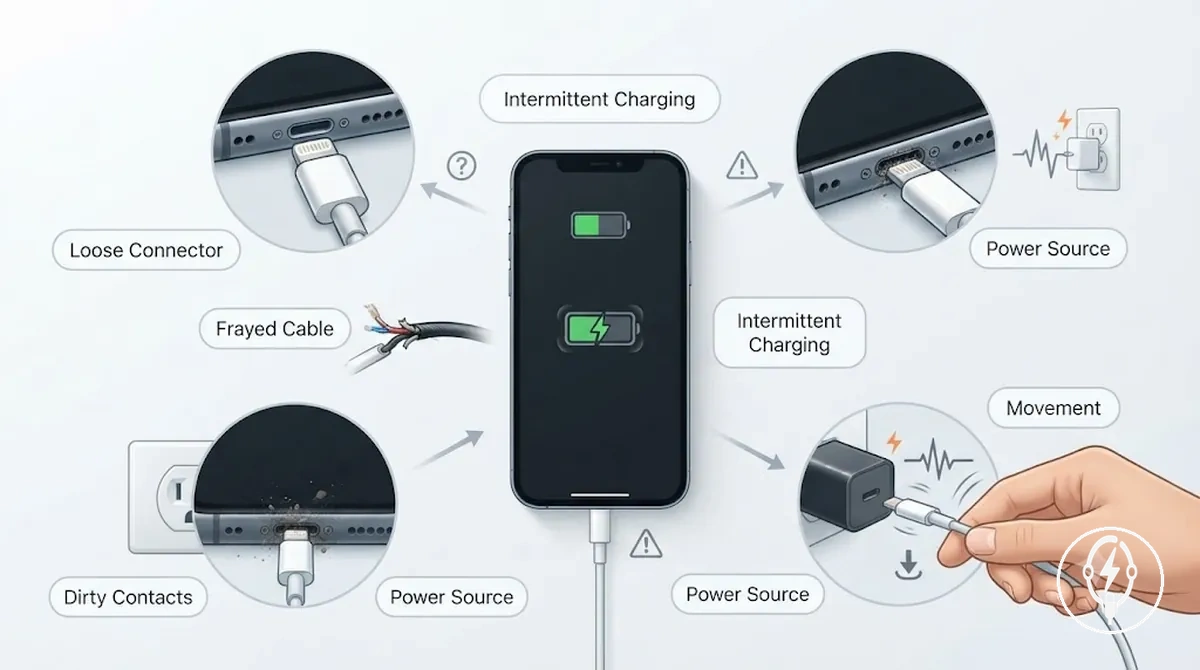
The checks below help determine whether intermittent charging is caused by unstable contact or inconsistent power delivery. For example, if charging disconnects only when the cable is moved but remains stable while the iPhone stays still, the symptom is more consistent with a movement-sensitive accessory connection than with a charging interruption that occurs while the phone remains stationary.
- Loose connector: A loose connector fit can cause the iPhone to repeatedly connects and disconnects because electrical contact is interrupted whenever the connector shifts position. Apple Support recommends confirming that the connector is fully inserted and remains secure during normal use.
- Frayed cable: A frayed cable, cracked insulation, or bent connector can interrupt power delivery when the cable is flexed, causing intermittent charging or repeated charging drops. Replace visibly damaged charging accessories instead of continuing to use them.
- Dirty contacts: Lint, dust, or other debris on the charging connector or inside the charging port can reduce electrical contact and trigger repeated charging tones. Apple Support advises inspecting the connector and carefully removing debris with a non-metallic tool before assuming accessory failure.
- Unstable outlet or adapter: A loose wall outlet, worn USB power adapter, or unstable USB power source can repeatedly interrupt charging even when the cable appears undamaged. Testing the same accessory with another compatible outlet or adapter helps isolate the power source.
- Movement during charging: If charging drops only during movement during charging and remains stable while the phone and cable remain still, the behaviour is more consistent with unstable connector contact than with a continuous charging interruption under stationary conditions.
Accessory Not Supported or Too Much Power Messages
An accessory not supported or too much power message indicates that the iPhone cannot recognize, authenticate, or safely communicate with the connected charging accessory under the current connection conditions. According to Apple Support, these warning messages can be triggered by an unsupported accessory, failed cable authentication, moisture or debris affecting the charging connector, or a power mismatch between the accessory and the device rather than confirming that the accessory is counterfeit, unsafe, or permanently damaged. The main diagnostic condition is whether the warning disappears after reconnecting the accessory or after testing a different known-working compatible charging cable or adapter.
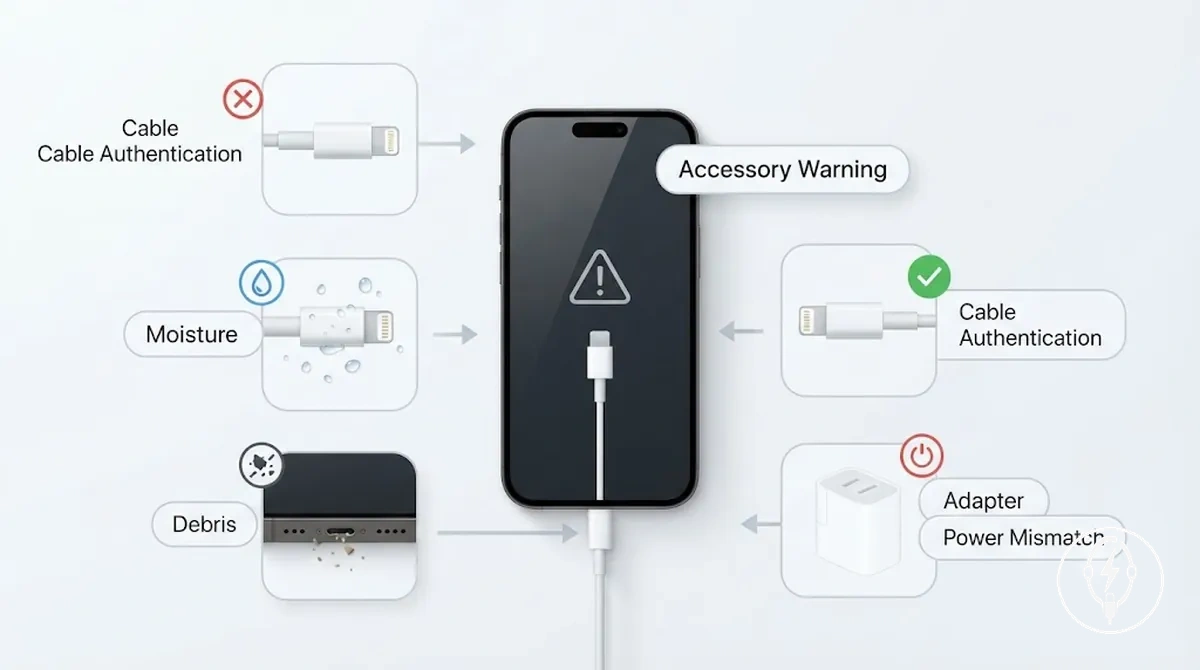
These charging alerts help verify whether the warning is caused by accessory recognition, connector condition, or power behaviour before assuming hardware failure. For example, if one charging cable repeatedly displays an accessory not supported message but a second compatible cable charges normally with the same iPhone and power adapter, Apple Support indicates the warning is more consistent with an accessory recognition or cable authentication issue than with an iPhone charging fault. If the same warning continues after swapping multiple compatible accessories, the charging problem may extend beyond the accessory and warrant further inspection of the iPhone charging system.
- Unsupported accessory: The iPhone cannot complete normal communication with the connected accessory and displays an accessory warning because accessory recognition has failed.
- Cable authentication: A damaged connector, unstable electrical contact, or failed cable authentication can prevent the iPhone from verifying the charging cable, triggering an accessory not supported message.
- Moisture or debris: According to Apple Support, moisture detection or debris inside the charging connector can interrupt electrical contact and generate charging alerts until the connector is clean and completely dry.
- Power mismatch: A too much power message can appear when the connected accessory requests or draws power outside the operating conditions expected by the iPhone, indicating a possible power mismatch rather than confirming accessory failure.
- Adapter behaviour: Repeating the same warning with different compatible charging accessories suggests the charging path or iPhone hardware should also be evaluated instead of replacing additional accessories.
Common Causes Across Cables, Adapters, Ports, and Wireless Chargers
Common causes of iPhone charging accessory problems usually involve one part of the charging setup rather than every component failing simultaneously. According to Apple Support, the safest troubleshooting method is to isolate the charging cable, connector, adapter, charging port contact, wireless charger, outlet, and power bank one at a time because the main diagnostic condition is whether the charging symptom follows a specific charging setup part or remains with the iPhone after testing a known-working compatible accessory.
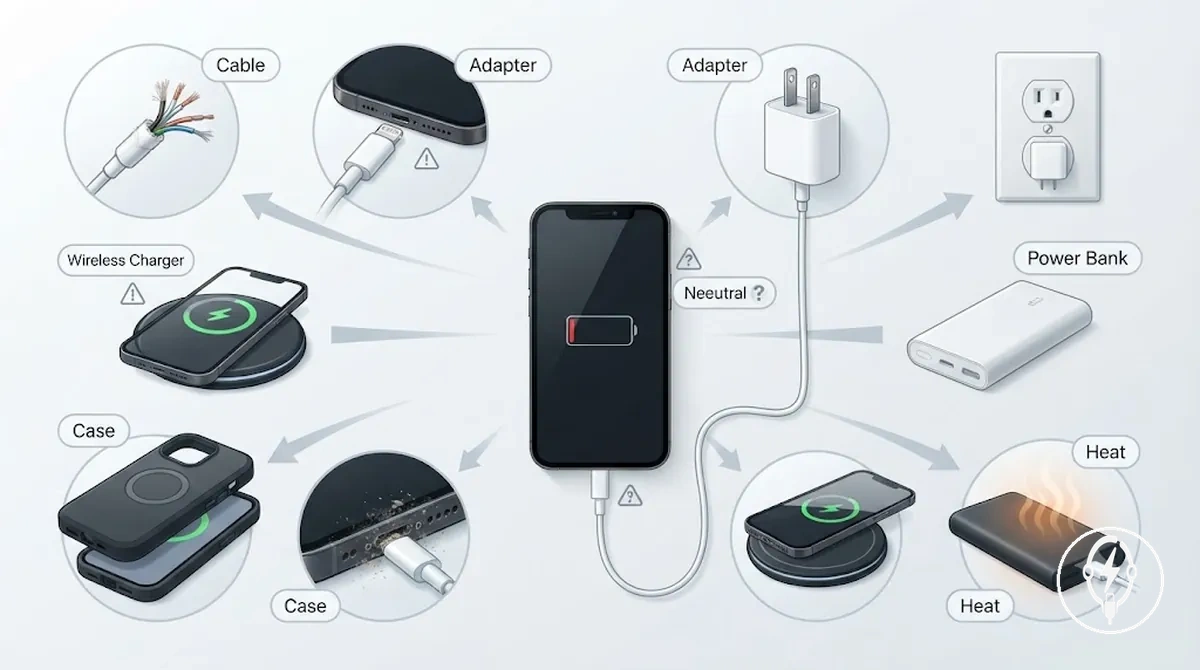
The table below organises the most common causes across charging setup parts, the condition each part can develop, the charging symptom it commonly produces, and the next safe check. For example, according to Apple Support, if replacing only the charging cable restores normal charging while the same adapter, outlet, and iPhone remain unchanged, the charging cable is the most likely failure point rather than the phone itself.
| Charging setup part | Likely condition | Possible charging outcome | Next check |
|---|---|---|---|
| Cable | Frayed insulation, bent connector, or internal conductor damage | No charging response, intermittent charging, or slow charging | Test with a known-working compatible cable |
| Connector | Loose fit, corrosion, or incomplete insertion | Charging repeatedly connects and disconnects | Reconnect firmly and inspect the connector for damage |
| Adapter | Insufficient or unstable power output | Slow charging or charging interruptions | Try another compatible USB power adapter |
| Charging port contact | Lint, debris, moisture, or poor electrical contact | Accessory warnings or inconsistent charging | Inspect and carefully clean the charging port following Apple Support guidance |
| Outlet | No power or unstable mains supply | No charging response or repeated charging interruptions | Verify the outlet using another electrical device |
| Power bank | Low battery capacity or inadequate output | Charging slows or stops unexpectedly | Confirm the power bank is charged and provides compatible output |
| Wireless charger | Off-center alignment or charging pad fault | Wireless charging interruption | Reposition the iPhone and test another compatible wireless charger |
| Case | Excessive thickness or magnetic interference | Wireless charging fails to start or becomes intermittent | Remove the case and test charging again |
| Heat | Elevated accessory or iPhone temperature | Charging speed is temporarily reduced while the device cools | Allow both devices to return to a normal operating temperature before retesting |
Cable Wear, Connector Damage, and Poor Contact
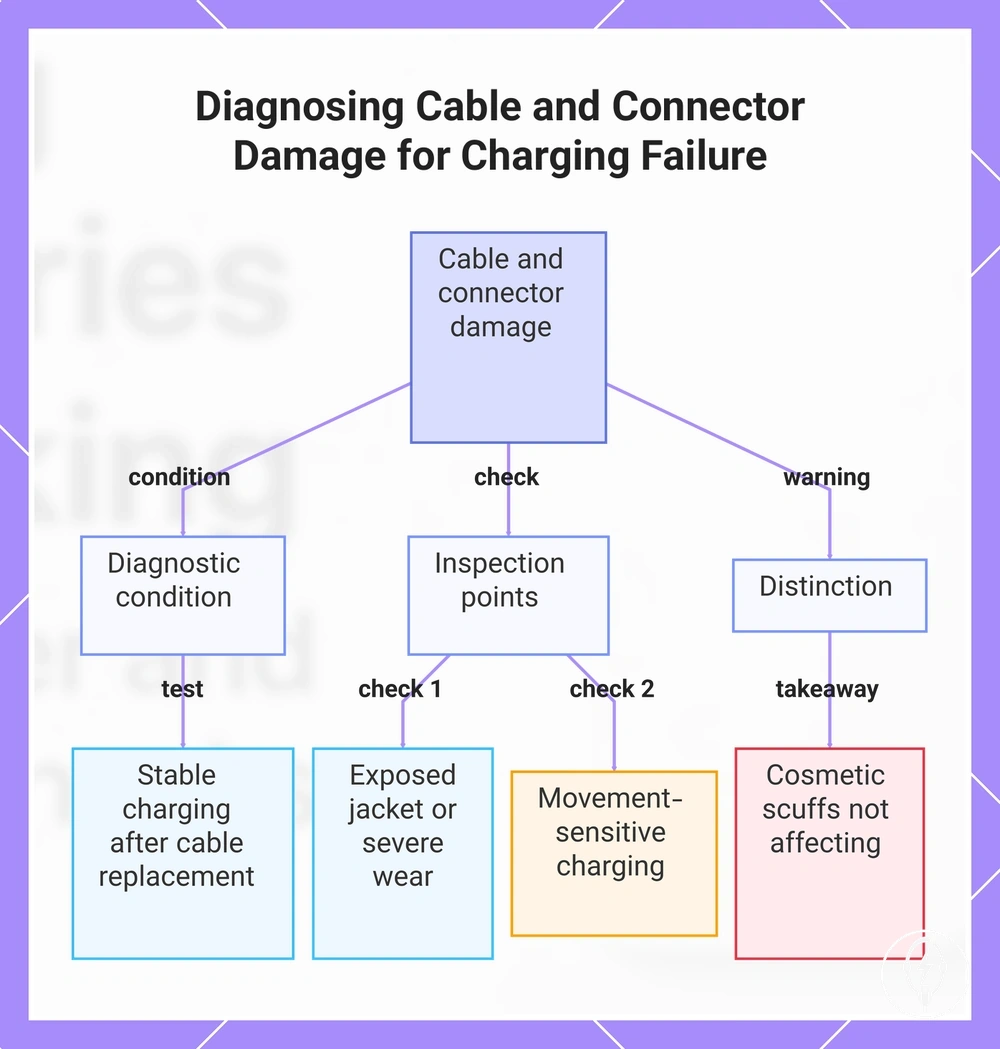
Cable wear, connector damage, and poor contact are common causes of local charging failure because they interrupt stable electrical contact between the charging cable and the iPhone. According to Apple Support, visible fraying, a bent connector, a loose fit, an exposed jacket, or connector contamination should be inspected before assuming an iPhone hardware fault, while charging failure is confirmed only if the same symptom consistently follows the same cable. The main diagnostic condition is whether charging becomes stable after replacing only the affected cable with a known-working compatible one.
Visible cable damage should be assessed by its effect rather than its appearance alone.
Visible cable damage should be assessed by its effect rather than its appearance alone. Cosmetic scuffs on the outer jacket may not affect charging reliability, whereas an exposed jacket, damaged connector, or severe cable wear can interrupt power delivery or create a safety risk if internal conductors are exposed. For example, a cable with superficial surface marks may continue charging normally, but a cable with fraying beside the connector that disconnects whenever it is bent is more consistent with reliability-affecting damage. If these signs indicate deeper cable and connector problems, inspect both the cable and connector before replacing accessories based only on cosmetic wear.
The inspection points below help distinguish cosmetic wear from visible conditions that are more likely to affect charging reliability.
The inspection points below help distinguish cosmetic wear from visible conditions that are more likely to affect charging reliability.
- Fraying: Split insulation or exposed fibres near the connector can indicate cable wear that may interrupt charging if internal conductors are damaged.
- Bent connector: A bent connector can prevent full connector seating, resulting in poor contact and intermittent charging.
- Loose fit: A connector that moves noticeably inside the charging port is more likely to create unstable electrical contact during normal use.
- Exposed jacket: Torn insulation exposing internal wiring is a visible safety concern and the cable should no longer be used.
- Connector contamination: Lint, dust, corrosion, or residue on connector contacts can increase electrical resistance and contribute to unreliable charging.
- Movement-sensitive charging: Charging that starts or stops only when the cable is moved commonly indicates unstable connector contact or internal cable damage rather than normal charging behaviour.
This chart shows the diagnostic condition, key inspection points, and the distinction between cosmetic wear and actual damage when troubleshooting charging failure caused by cable or connector issues.
Adapter, Outlet, and Power Source Mismatch
An adapter, outlet, or power source mismatch can make a working charging cable appear faulty because the charging source may not deliver stable or sufficient power to the iPhone. According to Apple Support, testing the same cable with a different known-working compatible adapter or power source is the recommended way to determine whether the charging accessory or the power source is responsible. The main diagnostic condition is whether charging resumes after changing only the adapter, outlet, or power source while keeping the same cable and iPhone unchanged.
Power-source compatibility should be checked component by component because each part can affect charging differently.
Power-source compatibility should be checked component by component because each part can affect charging differently. Apple Support notes that USB power adapters with lower power output and lower-output USB ports can charge more slowly than higher-power compatible adapters, while inactive wall outlets, unstable power strips, inconsistent car chargers, depleted power banks, or insufficient USB port output can prevent charging altogether. If repeated testing indicates broader charger compatibility issues, evaluate the charging source before replacing the cable. For example, if one USB power adapter produces no charging response but a second compatible adapter immediately charges the same iPhone through the same cable, the evidence is more consistent with an adapter or power source mismatch than with cable failure.
The checklist below helps isolate the charging source before diagnosing the cable.
The checklist below helps isolate the charging source before diagnosing the cable.
- Adapter wattage: Test another compatible USB power adapter if the current adapter delivers insufficient output or charges unusually slowly.
- Port type: Confirm the charging cable is connected to a compatible USB-C or USB-A port that provides charging output rather than a data-only or inactive port.
- Wall outlet: Verify power availability by testing another electrical device in the same wall outlet.
- Power strip: Connect the adapter directly to the wall outlet if the power strip intermittently loses power.
- Car charger: Check charging while the vehicle is running because available output may differ between ignition states.
- Power bank: Confirm the power bank has sufficient remaining battery capacity and an active charging output.
- USB port output: Test another USB port or another compatible charging source if the current port does not maintain stable charging.
Charging Port Debris or Loose Connection
Charging port debris or a loose connection can interfere with charging reliability by preventing stable electrical contact between the charging connector and the iPhone. According to Apple Support, visible lint, dust, moisture, incomplete connector seating, or a visible blockage should be inspected before concluding that the charging cable or adapter has failed. If resistance during insertion, visible liquid, corrosion, or physical damage is present, stop using the connection until it has been safely assessed.
The checks below help determine whether contact interference is affecting charging reliability rather than confirming an accessory fault.
The checks below help determine whether contact interference is affecting charging reliability rather than confirming an accessory fault. For example, if charging remains stable when the connector is fully seated but disconnects whenever slight movement sensitivity occurs, the symptom is more consistent with unstable contact than continuous power loss.
- Lint or dust: Visible lint or dust can reduce connector seating depth, resulting in poor contact, intermittent charging, or no charging response.
- Moisture: According to Apple Support, a moisture warning or visible liquid in the charging port requires disconnecting the charger and allowing the port to dry completely before reconnecting.
- Connector seating: The charging connector should insert fully without unusual resistance. A shallow fit can indicate charging port debris or another visible blockage affecting electrical contact.
- Visible blockage: Any obstruction that prevents full connector insertion can interrupt charging contact and reduce charging reliability.
- Movement sensitivity: Charging that starts or stops only when the connector moves is more consistent with a loose connection or unstable contact than with continuous power loss.
- Safety boundary: Stop inspection if you observe corrosion, visible damage, persistent insertion resistance, or liquid inside the charging port, because these conditions require further assessment rather than continued testing.
Wireless Charger Alignment, Case, and Power Issues
A wireless charger can fail to charge or charge intermittently when alignment, magnetic placement, case interference, adapter output, or charger surface conditions interrupt efficient power transfer between the charger and the iPhone. According to Apple Support, the first diagnostic step is to verify that the iPhone is positioned correctly on the charging pad or stand, the power adapter is compatible, and no physical obstruction affects charging. The main diagnostic condition is whether wireless charging resumes after correcting these wireless-specific conditions while wired charging continues to operate normally.
The checks below help determine whether the charging symptom is limited to the wireless charger rather than affecting the entire charging system.
The checks below help determine whether the charging symptom is limited to the wireless charger rather than affecting the entire charging system. For example, if the iPhone charges normally through a wired cable but repeatedly stops charging on the wireless charger until it is repositioned, the evidence is more consistent with a wireless charging condition than a broader charging fault.
- Pad or stand alignment: An off-center position on the charging pad or stand can interrupt wireless charging because the charging coils are no longer properly aligned. Apple Support recommends repositioning the iPhone centrally before testing further.
- Magnetic placement: On magnetic wireless chargers, incomplete magnetic attachment or visible sideways movement can reduce charging stability even though the charger remains powered.
- Case interference: Thick protective cases, metal accessories, card holders, or unsupported magnetic attachments can create case interference that weakens the wireless charging connection or prevents charging from starting.
- Foreign objects: Coins, keys, cards, or other foreign objects between the iPhone and the charging surface directly block energy transfer and should be removed before retesting.
- Adapter output: According to Apple Support, a wireless charger depends on a compatible USB power adapter for correct power delivery. An incompatible or insufficient adapter output can contribute to slow or interrupted wireless charging even when alignment is correct.
- Heat and charger cable condition: Elevated heat, an unstable charger cable connection, or visible cable damage can reduce charging reliability. Allow the wireless charger to cool and verify that its power cable remains securely connected before repeating the charging test.
Checks That Isolate the Failing Charging Accessory
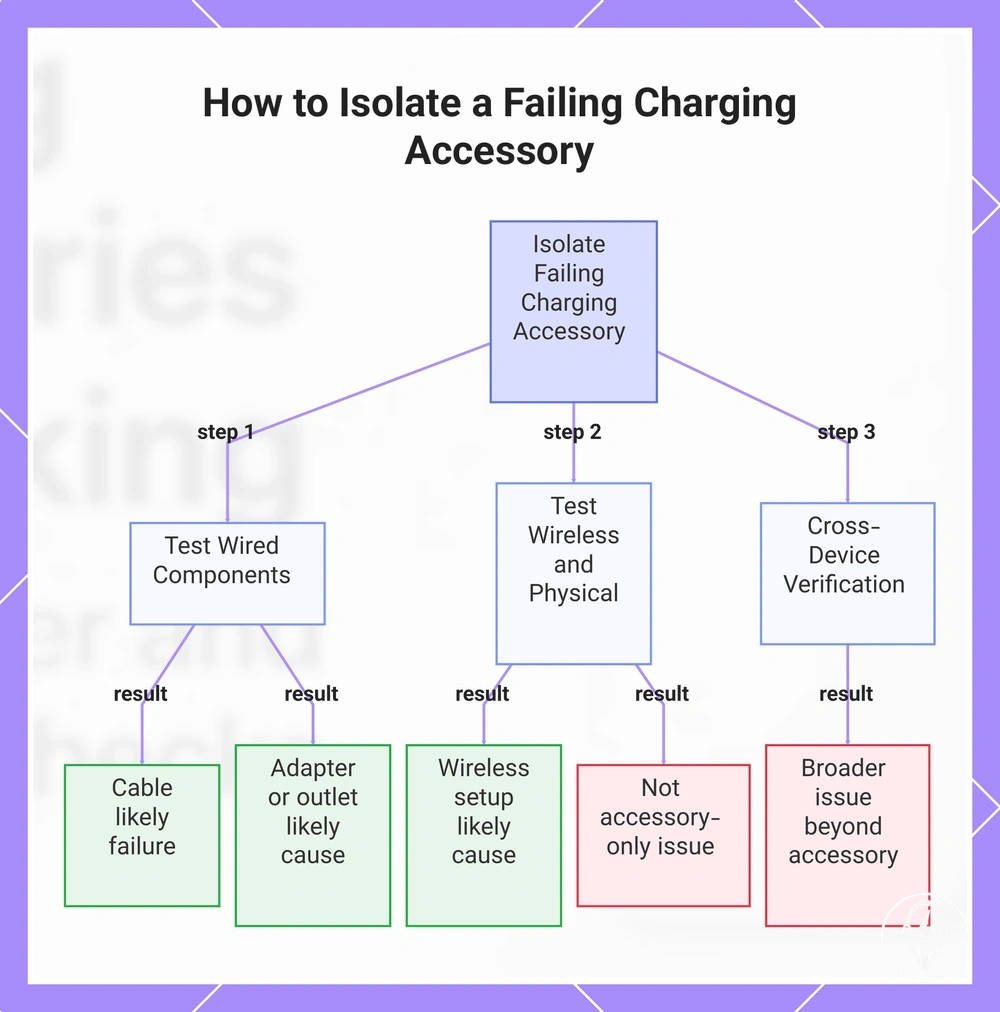
To isolate a failing charging accessory, test one variable at a time while keeping every other part of the charging setup unchanged. According to Apple Support, changing only one charging component between tests provides the clearest comparison because replacing multiple components simultaneously prevents reliable isolation of the charging symptom. The main diagnostic condition is whether the same charging problem consistently follows one accessory or remains with the iPhone after controlled comparison.
To isolate a failing charging accessory , test one variable at a time while keeping every other part of the charging setup unchanged.
The checklist below narrows the likely cause by comparing one charging setup component at a time rather than replacing accessories based on a single symptom. For example, if charging becomes stable after changing only the cable while the same iPhone, adapter, and outlet remain unchanged, the result supports the cable as the more likely cause instead of the adapter or charging port.
- Test the cable: Connect a known-working cable to the same iPhone, adapter, and outlet. If charging becomes stable only after this change, the original cable is the more likely failure point.
- Test the adapter: Keep the same cable connected and replace only the adapter with a known-working adapter. If charging resumes, the result supports an adapter or power-delivery issue rather than a cable problem.
- Verify the outlet or power source: Use the same cable and adapter with another outlet or confirmed power source. If charging works normally from the second outlet, the original power source is the more likely cause.
- Compare the wireless charger: If wired charging operates normally but the wireless charger does not, repeat the test with correct alignment and, where appropriate, without the protective case. If only wireless charging continues to fail, the result is more consistent with the wireless charging setup than the wired accessories.
- Check the case and port contact: Remove the protective case if it could interfere with wireless charging, then inspect the charging port for visible lint, debris, moisture, or incomplete connector seating. If the same accessories work correctly on another compatible device but the symptom remains, the evidence is less consistent with an accessory-only problem.
- Repeat with another known-working setup: Test the iPhone using another complete charging setup that includes a compatible cable, adapter, and power source. If the charging symptom remains unchanged across both setups, the result supports further investigation beyond a single charging accessory rather than replacement of another accessory.
This chart shows the step-by-step diagnostic process to identify which charging component is failing by testing one variable at a time.
Test with Another Cable, Adapter, and Outlet
Testing with another cable, adapter, and outlet is the most reliable way to identify which charging accessory is responsible because only one variable is changed while the unchanged iPhone acts as the test control. Apple Support recommends comparing one charging component at a time, since replacing multiple accessories simultaneously prevents a reliable comparison. The main diagnostic condition is whether the charging behaviour changes only after a single controlled swap.
The main diagnostic condition is whether the charging behaviour changes only after a single controlled swap.
The controlled sequence below verifies whether the cable, adapter, or power source is the most likely cause while preserving consistent test controls. For example, if charging resumes after replacing only the cable with a known-working cable, while the same iPhone, adapter, and outlet remain unchanged, the result is more consistent with a cable-related issue than an adapter or outlet problem.
- Swap the cable: Connect a known-working cable while keeping the same adapter, outlet, and unchanged iPhone. If charging starts normally, the original cable is the more likely cause.
- Swap the adapter: Reconnect the original cable and replace only the adapter with a known-working adapter. If charging resumes, the result is more consistent with an adapter-related power delivery issue.
- Test a different outlet: Keep the same cable and adapter connected, then plug the adapter into a different outlet using direct wall power instead of a power strip or extension lead. If charging returns, the original outlet or intermediate power source is the more likely cause.
- Keep the iPhone unchanged: Do not replace the phone during the swap test. Keeping the unchanged iPhone as one of the test controls ensures the observed charging result is associated with the accessory being tested rather than another variable.
Check for Damage Before Continued Use
Visible damage to a charging cable, power adapter, or connector is a clear stop-use condition because continued charging with a damaged accessory can result in unreliable electrical contact or overheating. According to Apple Support, accessories with exposed conductors, melted plastic, liquid damage, or physical damage should no longer be used. If any of these visible damage signs are present, discontinue continued use of the accessory while troubleshooting continues.
They distinguish visible safety-related conditions from cosmetic wear without expanding into repair advice.
The damage signs below help determine when a charging accessory has moved beyond normal wear and should be removed from service. They distinguish visible safety-related conditions from cosmetic wear without expanding into repair advice.
- Exposed wires: Exposed wires or visible internal conductors indicate damaged insulation and require the cable to be taken out of service immediately.
- Bent connectors: Bent connectors that no longer insert fully or remain loose during charging can interrupt electrical contact and should not continue to be used.
- Scorching or melted plastic: Scorching, burn marks, discolouration, or melted plastic are visible signs of overheating and the affected charging accessory should be discontinued.
- Loose prongs: A power adapter with loose prongs or damaged pins can create an unstable connection to the wall outlet and should not remain in use.
- Unusual heat: If a charging accessory develops unusual heat during normal charging or becomes noticeably hotter than under previous normal operation, stop using it until its condition has been assessed.
- Cracked housings: A cracked charger or adapter housing that exposes internal components or separates during normal handling should be treated as an unsafe accessory and removed from use.
Compare Wired and Wireless Charging Behavior
Charging behavior helps distinguish an accessory-path problem from a broader iPhone charging problem by comparing wired charging and wireless charging using the same iPhone. According to Apple Support, if one charging path works while the other does not, the charging fault is more likely to be isolated to the components unique to that charging method rather than affecting the entire device. The main diagnostic condition is whether the charging result changes only after switching between the wired and wireless charging paths.
The comparison below organises the most useful charging-path patterns to help identify the more likely source of the problem.
The comparison below organises the most useful charging-path patterns to help identify the more likely source of the problem. For example, if the same iPhone charges normally through a cable but not on a wireless charger, the observed charging behavior is more consistent with a wireless charging-path issue than a general iPhone charging fault.
| Charging behavior | Primary components to evaluate | Likely interpretation |
|---|---|---|
| Wired-only charging fails while wireless charging works | Cable, adapter, port contact, or charging connector | The charging behavior is more consistent with the wired charging path than with an overall iPhone charging problem. |
| Wireless-only charging fails while wired charging works | Wireless charging pad, alignment, protective case, or wireless charger power connection | The charging behavior is more consistent with the wireless charging path than with the wired charging accessories. |
| Both methods fail with known-working compatible accessories | Shared power source, broader charging conditions, or the iPhone charging system | The charging behavior is less consistent with a single accessory-path problem and may indicate a condition beyond one charging accessory. |
Fixes That Stay Within Charging Accessory Troubleshooting
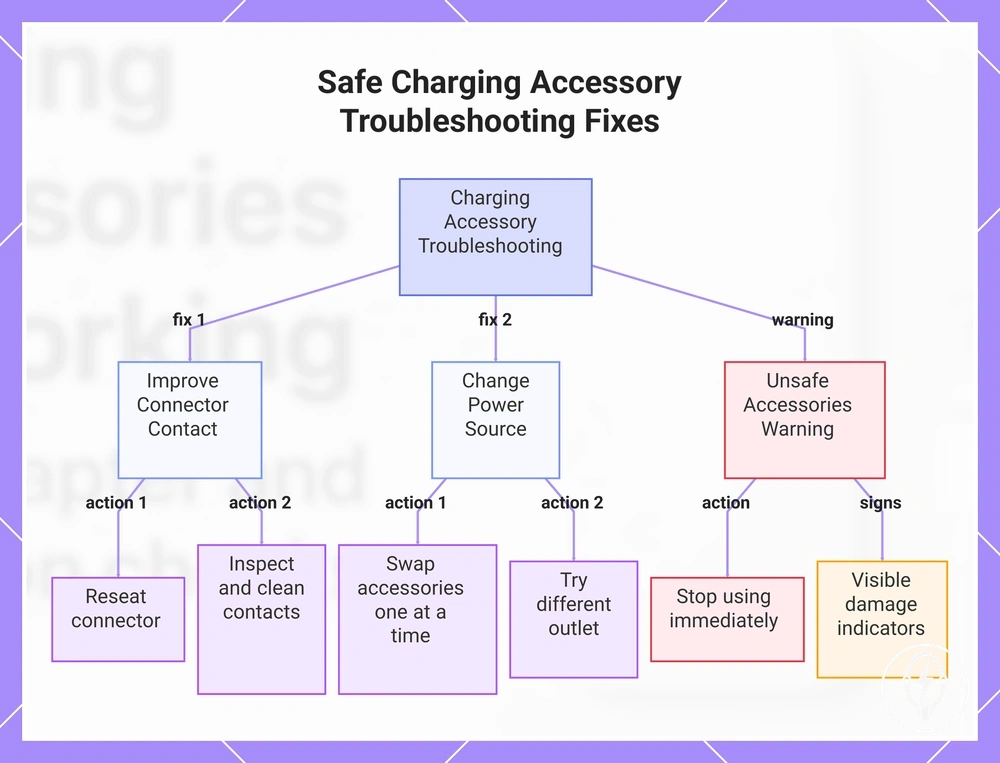
Charging accessory troubleshooting should begin with safe, accessory-level fixes before assuming the iPhone or its battery requires service. According to Apple Support, the most reliable approach is to correct charging setup conditions one at a time by improving connector contact, changing the power source, reducing wireless charging interference, or removing damaged accessories from use. If a charging accessory has exposed conductors, overheating, melted plastic, or visible physical damage, stop using it immediately rather than continuing to test with that accessory.
Charging accessory troubleshooting should begin with safe, accessory-level fixes before assuming the iPhone or its battery requires service.
These fixes focus on narrowing the likely charging accessory cause without performing invasive repairs or replacing multiple components simultaneously. Use one action at a time, then continue with correct accessory use before repeating the charging test so the result can be linked to a single setup change.
- Reseating: Disconnect and firmly reseat the charging connector, then retry charging. This addresses poor contact caused by incomplete connector insertion or slight movement.
- Swapping accessories: Replace only one charging accessory, such as the cable or power adapter, while leaving the remaining setup unchanged. If the charging result changes after one swap, that accessory becomes the more likely cause.
- Changing outlets: Move the same power adapter to a different wall outlet or confirmed power source to determine whether the original outlet is interrupting charging.
- Case interference: If wireless charging is inconsistent, temporarily remove thick protective cases, magnetic accessories, or objects between the iPhone and the charging pad, then retry charging after correct alignment.
- Cooling: If the iPhone or charging accessory becomes unusually warm, disconnect it and allow both components to return to a normal operating temperature before testing again, as thermal conditions can temporarily affect charging behaviour.
- Checking contacts: Inspect the charging connector and charging port for visible lint, dust, moisture, or debris that could prevent stable electrical contacts.
- Unsafe accessories: Stop using charging accessories with exposed wires, bent connectors, cracked housings, scorch marks, or melted plastic because these visible conditions indicate physical damage rather than a normal charging fault.
This chart shows the safe, accessory-level fixes to try before assuming the iPhone or battery needs service, including a critical warning about damaged accessories.
Reconnect, Reseat, and Swap the Accessory Setup
Reconnect, reseat, and swap the accessory setup by changing only one connection point at a time while leaving the remaining charging components unchanged. According to Apple Support, reconnecting one accessory at a time helps isolate whether an unstable connector seating or a single charging accessory is causing the interruption. If charging becomes stable only after one controlled change, treat the temporary improvement as evidence of poor contact rather than a permanent solution.
The steps below verify whether reconnecting or reseating restores a stable position or whether swapping one accessory changes the charging result.
The steps below verify whether reconnecting or reseating restores a stable position or whether swapping one accessory changes the charging result. For example, if reconnecting the cable produces only a temporary improvement but swapping the cable restores stable charging, the cable is the more likely source of the interruption.
- Reconnect the phone-side connector: Unplug and reconnect the charging connector, check the correct orientation, and ensure it is fully seated without forcing the connector.
- Reseat the adapter connection: Disconnect and reconnect the cable at the adapter port, then confirm the power adapter is firmly inserted into the wall outlet.
- Reconnect the wireless charger cable: If using wireless charging, unplug and reconnect the cable at both the wireless charging pad and the power adapter before testing again.
- Test a stable position: Leave the iPhone and charging cable stationary for at least 30 seconds while charging. If charging stops only when the connector moves, the observed result is more consistent with poor contact than with a stable charging connection.
- Swap one accessory: Replace only one part of the accessory setup, such as the cable or adapter, and repeat the same charging test. If the changed result consistently follows the swapped accessory, that accessory is the more likely issue, whereas a temporary improvement after reseating alone indicates the connection should continue to be monitored.
Remove Safe Surface Debris from Charging Contacts
Safe surface debris removal is limited to visible dry lint and loose particles on exposed charging contacts, the cable connector surface, the wireless charger surface, and other outer contact areas. According to Apple Support, charging connectors and accessories should remain clean and dry, and charging should not continue if moisture is present. Removing only visible surface debris may improve contact when debris is the cause, but it does not resolve internal connector damage or conditions requiring deep port cleaning.
The checks below verify whether visible surface debris is contributing to poor contact while keeping maintenance limited to exposed surfaces.
The checks below verify whether visible surface debris is contributing to poor contact while keeping maintenance limited to exposed surfaces. If no visible debris is present or charging remains unchanged after these checks, further cleaning should be considered only when inspection confirms debris and appropriate safe methods are available.
- Dry lint: Remove only visible dry lint resting on exposed charging contacts or surrounding outer contact areas without pushing debris further into the charging port.
- Cable connector surface: Inspect the cable connector surface for visible surface lint or debris that could contribute to poor contact, then reconnect the cable and check whether charging stability improves.
- Wireless charger surface: Remove visible dust or any foreign object from the wireless charger surface, as objects between the charger and the iPhone can interrupt wireless charging.
- Outer contact areas: Ensure exposed outer contact areas remain dry and free from visible surface debris before reconnecting the charging accessory.
- Safety boundary: Do not use liquids or perform deep port cleaning during this maintenance step. If inspection identifies debris beyond the visible surface, deeper cleaning should only be considered when safe tools are available and the debris can be removed without increasing the risk of damage.
Reduce Heat, Case Interference, and Charging Load
Heat, case interference, and charging load can make a working charging accessory appear faulty because elevated phone temperature, obstructed wireless charging, or intensive device activity can temporarily change charging behavior. According to Apple Support, iPhone charging may slow, pause, or resume after the device cools if temperature limits are reached, and wireless charging performance can be affected by protective cases or incorrect positioning. If the iPhone feels unusually warm, allow it to cool naturally before repeating the same charging test with the same accessory.
If the iPhone feels unusually warm, allow it to cool naturally before repeating the same charging test with the same accessory.
The checks below help determine whether controllable usage conditions are affecting charging behavior rather than indicating an accessory failure. For example, if wireless charging resumes after improving wireless alignment or removing a thick case while the same charger is used, the condition is more consistent with usage-related interference than with a defective charging accessory.
- Phone temperature: If the phone temperature is noticeably elevated during charging, allow the iPhone to cool before testing again because Apple Support states that thermal management can temporarily slow or pause charging to protect the device.
- Case thickness: Excessive case thickness, attached wallets, or metal accessories can create case interference during wireless charging. Temporarily removing the case helps determine whether the obstruction is interrupting power transfer.
- Wireless alignment: Place the iPhone centrally on the wireless charging pad or stand. Incorrect wireless alignment, especially when combined with case interference, is more likely to interrupt wireless charging than to indicate a cable-related fault.
- High-power app use: Continuous gaming, navigation, video recording, or other high-power app use increases charging load, which can reduce the visible charging rate while those activities continue.
- Adapter strain: Avoid pulling, twisting, or placing tension on the charging cable or power adapter because connector movement combined with charging strain can contribute to intermittent charging symptoms.
- Ventilation: Charge the iPhone on a hard, open surface with adequate ventilation. A cooler charging setup helps distinguish temporary heat-related charging behavior from an actual accessory problem.
When the Issue Is Not the Charging Accessory
The issue is not the charging accessory when the same charging symptom persists after testing multiple known-working accessories and both wired and wireless charging methods under controlled conditions. According to Apple Support, if compatible cables, adapters, power sources, and charging methods have been exchanged individually and the symptom does not change, accessory-only troubleshooting has reached its scope limit. The main diagnostic condition is that repeated controlled accessory swaps produce the same charging result.
The main diagnostic condition is that repeated controlled accessory swaps produce the same charging result.
The criteria below organise the boundary between accessory-related problems and situations that are more consistent with a possible phone-side issue without implying an exact diagnosis. A repeated symptom across independent tests provides a stronger indication than a single unsuccessful charging attempt.
| Observed condition | Boundary interpretation |
|---|---|
| The same charging symptom remains after testing multiple known-working accessories. | The repeated result is more consistent with a non-accessory issue than with one faulty charging accessory. |
| A persistent warning, including a charging or accessory-related message, remains after compatible accessory swaps. | Replacing another cable or adapter alone is unlikely to remove the warning because the symptom remains unchanged. |
| The same battery indicator or software indicator continues after repeated controlled charging tests. | The charging behaviour extends beyond accessory comparison and may justify further phone-side evaluation without identifying a specific fault. |
| Visible charging-port or connector damage remains after changing accessories. | The unchanged physical condition makes further accessory substitution unlikely to change the observed result. |
| Both wired and wireless charging fail with compatible, known-working accessories. | The repeated failure indicates that accessory troubleshooting has reached its scope limit, although it does not confirm an internal iPhone fault or guarantee a repair outcome. |
When to Clean or Inspect the Charging Port More Carefully
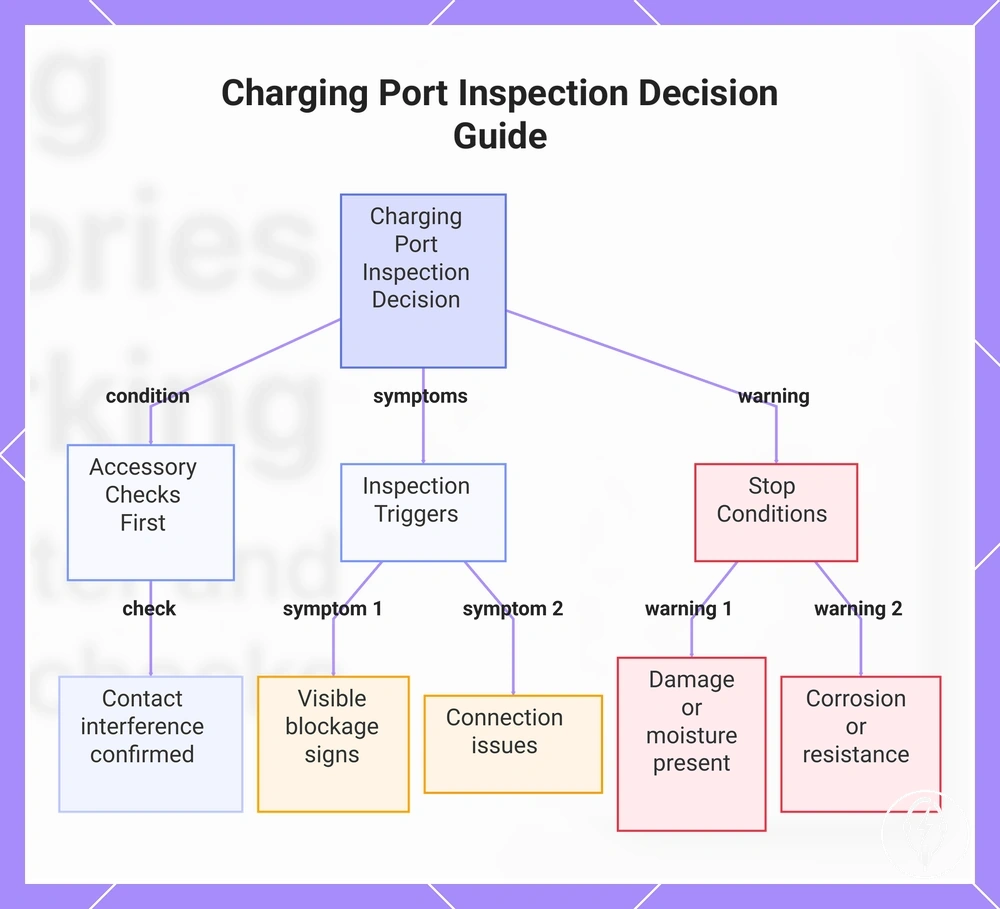
Inspect the charging port more carefully only after charging accessory checks indicate that contact interference is a more likely cause than a faulty cable or adapter. According to Apple Support, visible contamination or incomplete connector insertion can interrupt electrical contact even when compatible accessories are functioning correctly. If inspection reveals damage, moisture, corrosion, or unusual resistance while inserting the connector, stop further cleaning attempts and do not continue beyond visual inspection.
The checklist below identifies the symptoms that justify inspection while avoiding unnecessary or unsafe maintenance.
A closer charging port inspection helps confirm whether contact interference is responsible before moving to a dedicated cleaning process. The checklist below identifies the symptoms that justify inspection while avoiding unnecessary or unsafe maintenance.
- Visible debris: Inspect the charging port when visible debris or a lint-like blockage is present around the connector opening because it can interfere with electrical contact.
- Connector not seating: If the charging connector is not seating fully or stops before complete insertion, inspect the charging port before replacing another charging accessory.
- Intermittent charging: If intermittent charging occurs only when the connector moves, closer inspection is appropriate because movement-related contact loss can indicate a possible blockage.
- Contact warnings: Repeated contact warnings after testing known-working compatible accessories suggest that charging port inspection is the next appropriate diagnostic step rather than another accessory swap.
- Boundary: Stop immediately if damage, moisture, corrosion, or persistent insertion resistance is present. If none of these conditions are observed and inspection suggests only surface contamination, continue with the dedicated guide to clean charging accessories rather than attempting deeper charging-port cleaning in this section.
This chart shows the conditions that justify inspecting the charging port, including the precondition, observable symptoms, and safety boundaries.
When the Charging Accessory Should Be Replaced
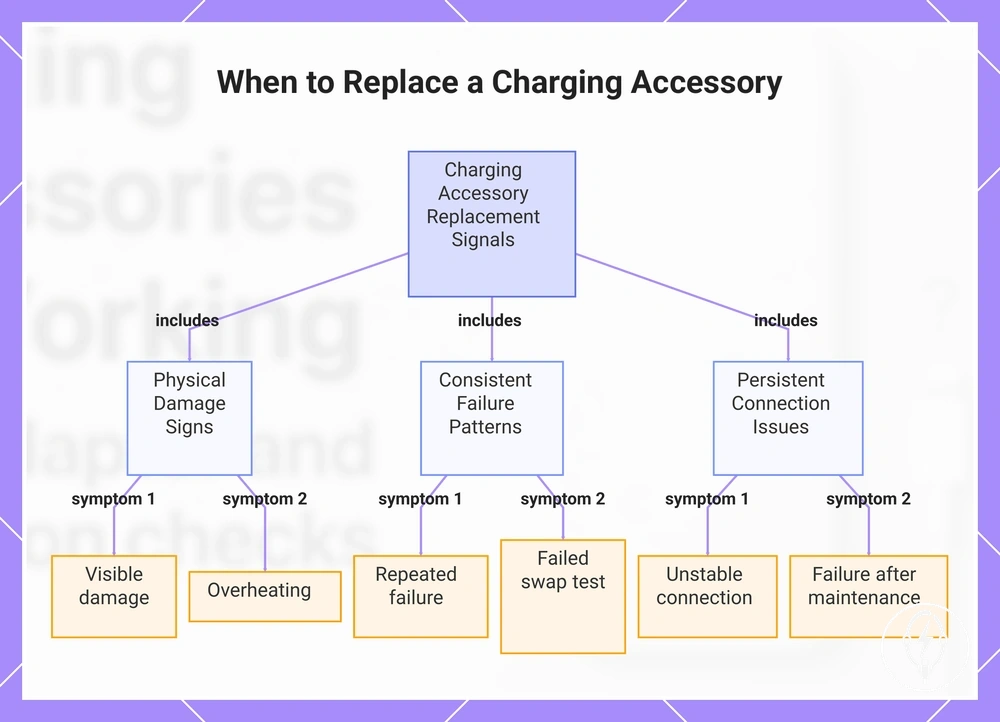
Replace a charging accessory when troubleshooting consistently identifies the same cable, power adapter, or wireless charger as the source of the charging problem rather than the iPhone or its charging port. According to Apple Support, accessories with visible damage, repeated overheating, or persistent charging failure after controlled comparison with compatible, known-working accessories should no longer remain in use. When replacement is necessary, choose a compatible charging accessory that matches the failed accessory type and the device's charging requirements.
These conditions support a replacement decision based on compatibility, safety, and the confirmed failed accessory type.
The replacement signals below help confirm when accessory-level troubleshooting has reached a practical endpoint instead of indicating another cleaning or testing cycle. These conditions support a replacement decision based on compatibility, safety, and the confirmed failed accessory type. When these replacement signals are present, continue with the guidance on when to replace accessories before selecting a compatible replacement.
- Repeated failure: The same cable or power adapter repeatedly fails while a compatible, known-working equivalent charges the same iPhone successfully under identical test conditions.
- Visible damage: Exposed wires, bent connectors, cracked housings, melted plastic, or scorch marks are confirmed accessory failure signs, and Apple Support advises stopping use of damaged charging accessories.
- Overheating: A charging accessory repeatedly becomes unusually hot during normal charging after outlet, cable, and connection checks have been completed, indicating replacement is safer than continued use.
- Unstable connection: Charging continues to start and stop because of an unstable connection or persistent poor contact even after safe inspection and proper connector seating.
- Failed swap test: A failed swap test consistently shows that the charging problem follows one cable or adapter instead of the iPhone, charging port, or power source.
- Failure after maintenance: Reliable charging does not return after safe surface cleaning, controlled accessory swapping, and compatibility checks, making replacement the most reasonable accessory-level outcome.
This chart shows the key signals that indicate a charging accessory should be replaced rather than the iPhone or its charging port.