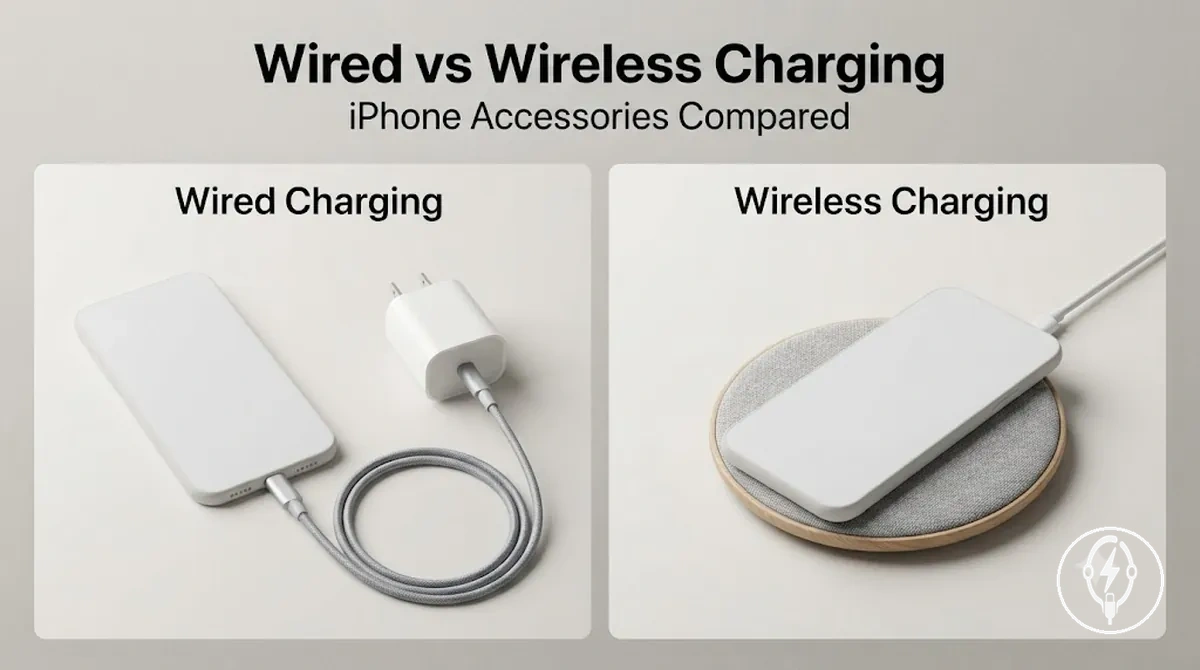
Wired and Wireless iPhone Charging Compared
Wired charging usually provides faster and more consistent charging performance, while wireless charging usually provides greater convenience and placement flexibility for iPhone charging accessories. According to Apple, charging performance depends on the iPhone model, the charger and power adapter, cable quality, wireless alignment, case compatibility, and the charging technology in use. The main decision is therefore whether your priority is shorter charging time under compatible conditions or easier everyday charging with fewer cable connections.
These two charging methods use different hardware requirements, making compatibility, alignment, and charging conditions important comparison points.
Wired charging transfers electrical power through a physical cable connected to a compatible power adapter, while wireless charging transfers power by inductive charging based on the Qi standard. Apple specifies that MagSafe is its magnetic wireless charging system that aligns compatible iPhone models with compatible chargers to improve charging position compared with standard Qi placement. These two charging methods use different hardware requirements, making compatibility, alignment, and charging conditions important comparison points.
According to Apple, keeping the device properly aligned and using compatible charging accessories helps maintain expected charging performance.
For example, if you connect a compatible iPhone to a compatible USB-C cable and power adapter before leaving home, wired charging will usually restore battery capacity more quickly than placing the same phone on a wireless charging pad under similar conditions. By contrast, placing the iPhone on a MagSafe charger at a desk or bedside removes the need to plug in a cable each time, although charging performance depends on correct magnetic alignment, compatible accessories, case thickness, and the heat generated during wireless power transfer. According to Apple, keeping the device properly aligned and using compatible charging accessories helps maintain expected charging performance.
The table below compares wired and wireless iPhone charging by method, trade-off, and everyday decision context rather than ranking one option as universally better.
The table below compares wired and wireless iPhone charging by method, trade-off, and everyday decision context rather than ranking one option as universally better.
| Method | Usually stronger for | Main condition | Main limitation |
|---|---|---|---|
| Wired charging | Charging speed and connection reliability | Requires a compatible cable, power adapter, charger, and supported iPhone | Requires a physical cable connection during charging |
| Wireless charging (Qi or MagSafe) | Convenience, flexible placement, and reduced cable handling | Requires a compatible Qi or MagSafe charger, suitable case fit, and correct device alignment | Charging performance can decrease if alignment is poor or incompatible accessories are used |
Table of Contents
How Wired and Wireless iPhone Charging Work Differently
Wired and wireless iPhone charging differ by how power reaches the iPhone. Cable-based charging transfers electrical power through direct physical contact between the iPhone connector and a compatible cable, while wireless charging transfers power by electromagnetic induction between charging coils without plugging in a connector. Apple specifies that MagSafe is a magnetic alignment system for compatible iPhone models that improves positioning while remaining a wireless charging method, so the core distinction is physical contact versus inductive power transfer.
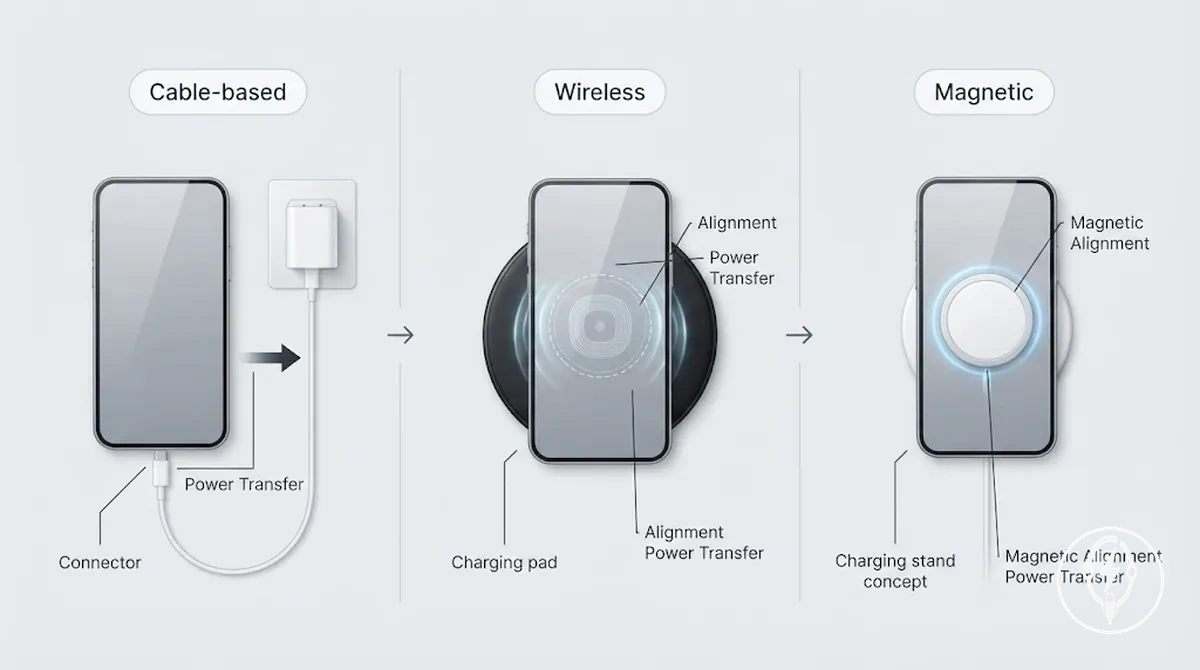
Cable-based charging uses direct connector contact, whereas wireless charging requires the iPhone's charging coil to align with the coil inside a Qi-compatible charging pad or charging stand. According to the Wireless Power Consortium, Qi is the international wireless charging standard based on inductive power transfer, while Apple states that MagSafe magnets help maintain alignment on supported iPhone models. iPhone charging accessories include cables, power adapters, charging pads, charging stands, and magnetic chargers that enable one of these charging methods. Because cable-based charging maintains continuous physical contact, it generally provides a more consistent power connection than a misaligned wireless charger.
A common misconception is that MagSafe is a separate charging technology.
A common misconception is that MagSafe is a separate charging technology. Apple defines MagSafe as magnetic alignment that works with Qi-based wireless charging rather than replacing it, so the charging method remains wireless even when magnets are used for positioning. The operational boundary is straightforward: cable-based charging uses physical contact, Qi wireless charging uses inductive alignment, and MagSafe adds magnetic alignment to that wireless process.
How Wired and Wireless iPhone Charging Work Differently is easiest to understand by comparing how each charging method transfers power, what must align, and the resulting practical effect.
How Wired and Wireless iPhone Charging Work Differently is easiest to understand by comparing how each charging method transfers power, what must align, and the resulting practical effect. The table below summarizes those operational differences before later sections compare charging performance, while the guide to wireless charging options focuses only on wireless-specific products and considerations.
| Charging method | How power transfers | What must line up | Practical effect |
|---|---|---|---|
| Cable-based charging | Direct electrical contact through a connector and charging cable | The connector must be fully inserted into the iPhone and connected to a compatible power adapter | Provides a consistent electrical connection because power flows through physical contact |
| Qi wireless charging | Inductive power transfer between transmitter and receiver coils | The iPhone charging coil should be positioned over the charging pad or charging stand coil | Charging continues only while the coils remain sufficiently aligned |
| MagSafe magnetic charging | Qi-based inductive power transfer with magnetic alignment | Integrated magnets help position compatible iPhone models over the charging coil | Improves alignment consistency while remaining a wireless charging method |
Cable-Based iPhone Charging
Cable-based iPhone charging is a charging method that delivers electrical power through direct contact between a charging cable, its connector, the iPhone phone port, and a compatible power adapter. Apple specifies that an iPhone charges through a wired connection when a compatible cable is connected to a compatible USB power adapter or another supported power source. The charging path is therefore the cable, connector, phone port, and adapter working together through direct contact.
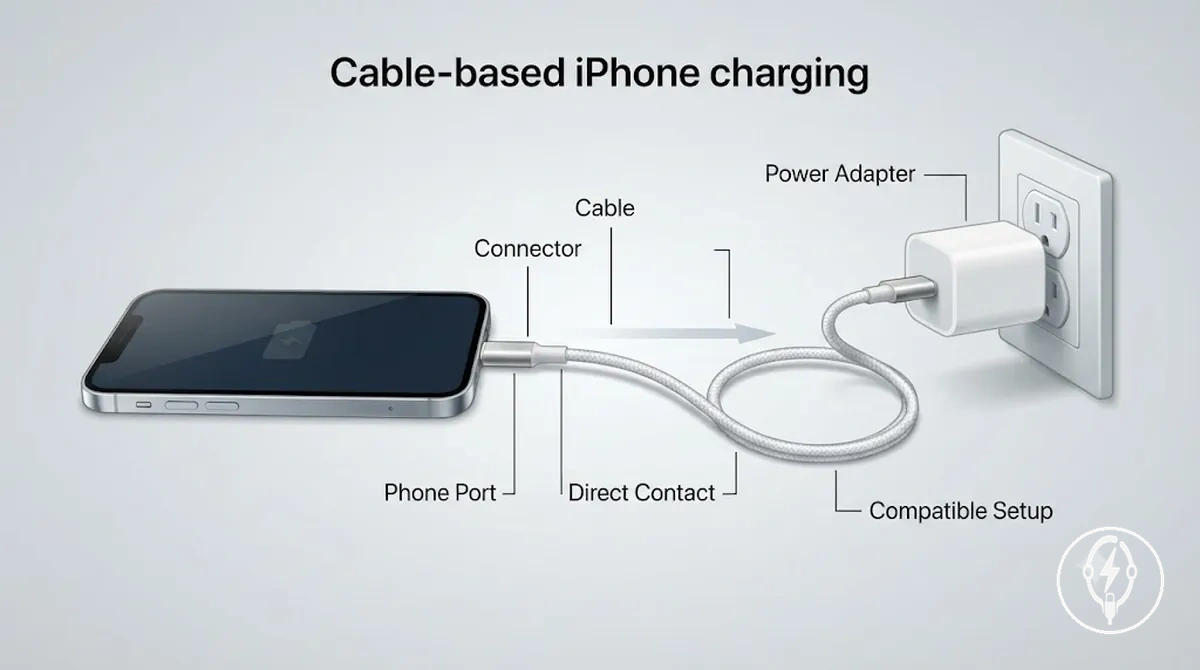
For example, connecting a compatible USB-C cable to a compatible USB-C power adapter and inserting the connector fully into an iPhone with a USB-C port creates a compatible setup that supports cable-based charging, according to Apple. Charging speed and charging reliability depend on the cable, adapter, and phone port supporting the required power and fitting correctly, while an incompatible connector, damaged cable, or unsupported adapter can prevent charging or reduce available charging performance. The cable, adapter, and phone port must all be compatible for the charging path to function correctly.
Wireless Pads, Stands, Qi, and MagSafe Charging
Wireless iPhone charging is a charging method that transfers electrical power through inductive charging between the charging coil inside the iPhone and the coil inside a compatible wireless charger without requiring a physical cable connection during charging. According to the Wireless Power Consortium, Qi is the international wireless charging standard used by compatible charging pads and charging stands, while Apple specifies that MagSafe uses magnetic alignment to position supported iPhone models while remaining a Qi-based wireless charging method. Correct alignment and coil contact are the conditions required for consistent wireless charging.
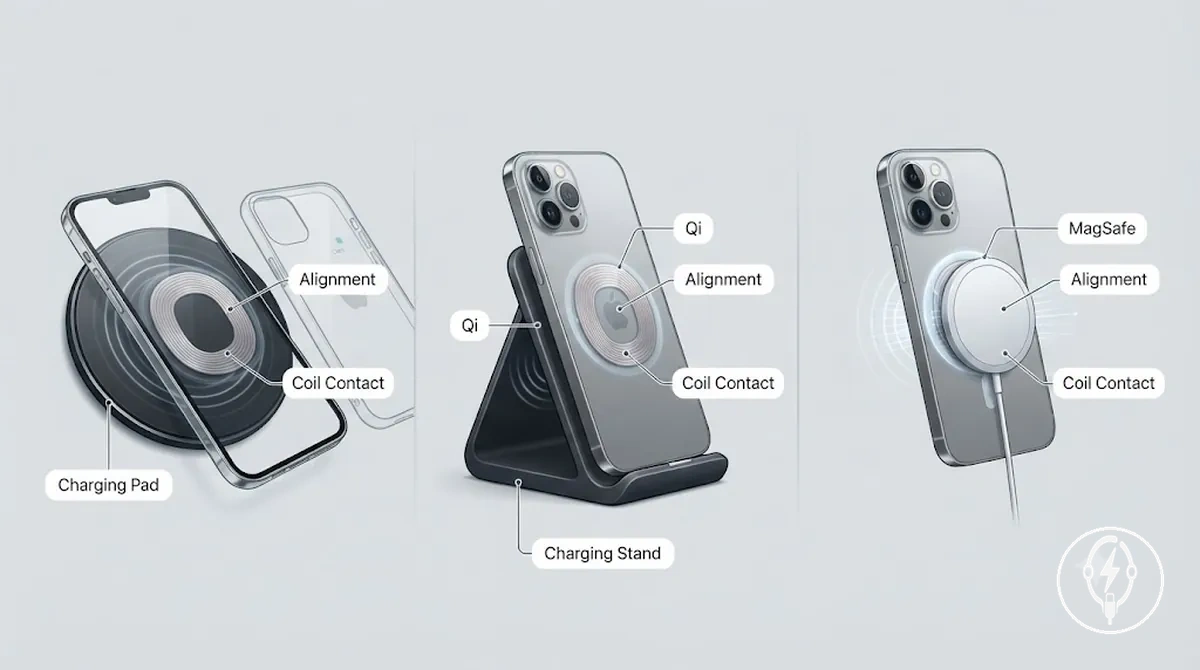
Wireless Pads, Stands, Qi, and MagSafe Charging include flat charging pads, charging stands, Qi chargers, and magnetic chargers that all rely on inductive charging rather than direct electrical contact. For example, placing a compatible iPhone centrally on a Qi charging pad or allowing MagSafe magnets to align a supported iPhone improves coil contact, whereas poor placement or a case that interferes with magnetic alignment can reduce charging consistency or increase heat during charging. MagSafe therefore remains a wireless charging method, with magnetic alignment improving placement rather than creating a separate charging technology.
Charging Speed and Power Delivery Differences
Charging speed and power delivery are usually higher with wired charging than with wireless charging when the iPhone, charger, cable, and power adapter all support the required charging capability. According to Apple, charging performance is determined by the iPhone model, adapter wattage, cable support, and charger compatibility, while the Wireless Power Consortium states that wireless charging performance also depends on the supported Qi standard and correct coil alignment. Power delivery is therefore conditional on the complete charging setup rather than the charging method alone.
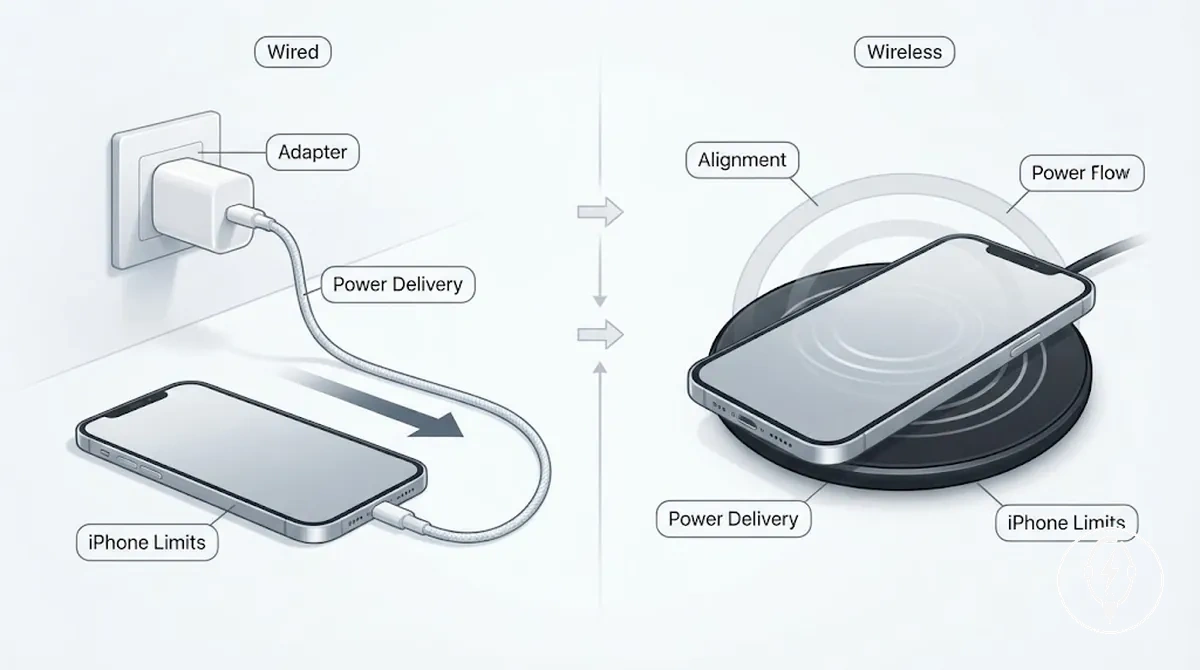
For a fast top-up, wired charging provides the most direct power path because power is transferred through a cable instead of inductive charging. According to USB-IF, the USB Power Delivery specification supports negotiated power delivery of up to 240 W across compatible USB-C devices, but Apple specifies that each iPhone only draws the charging power supported by its own hardware and charging controller. For example, replacing a USB Power Delivery-compatible cable or adapter with a non-compatible accessory prevents the iPhone from negotiating its supported charging level, reducing available charging performance even though the phone itself has not changed.
A common misconception is that every wireless charger delivers the same charging speed.
A common misconception is that every wireless charger delivers the same charging speed. In practice, wireless charging performance depends on the supported wireless standard, correct alignment between the charging coils, compatible accessories, and the charging limits built into the iPhone. According to the Wireless Power Consortium, poor alignment reduces power-transfer efficiency, so incorrect placement or an incompatible case can reduce charging consistency even when the charger supports a higher charging capability.
The table below organises the main decision criteria, while more detailed guidance on fast charging performance explains compatible charging requirements in greater depth.
Charging Speed and Power Delivery Differences are easier to compare by evaluating the conditions that affect charging performance instead of expecting fixed charging times or universal speed rankings. The table below organises the main decision criteria, while more detailed guidance on fast charging performance explains compatible charging requirements in greater depth.
| Charging method | Speed condition | What limits it | Best practical use |
|---|---|---|---|
| Wired charging | Compatible iPhone, power adapter, and charging cable support the required power delivery | Adapter wattage, cable support, charging protocol, and iPhone charging limits | Fast top-ups when all compatible components support higher power delivery |
| Wireless charging | Compatible Qi or magnetic charger with correct alignment and coil contact | Wireless standard, charger alignment, case fit, and iPhone charging limits | Routine charging where convenient placement is the priority over the quickest top-up |
For everyday charging, the most effective choice depends on whether the priority is reducing charging time or simplifying routine charging. Choosing compatible accessories for the intended charging method has a greater effect on charging performance than changing between wired and wireless charging alone.
Efficiency, Heat, and Energy Loss
Efficiency, heat, and energy loss differ between wired charging and wireless charging because each charging method transfers energy differently, and real-world charging performance depends on the complete charging setup. According to Apple, charging efficiency is influenced by the iPhone model, compatible charger, cable or charging pad, and correct positioning, while the Wireless Power Consortium explains that Qi wireless charging relies on proper alignment between transmitter and receiver coils for efficient energy transfer. Heat and efficiency therefore vary with transfer method, alignment, and accessory compatibility rather than with the charging method alone.
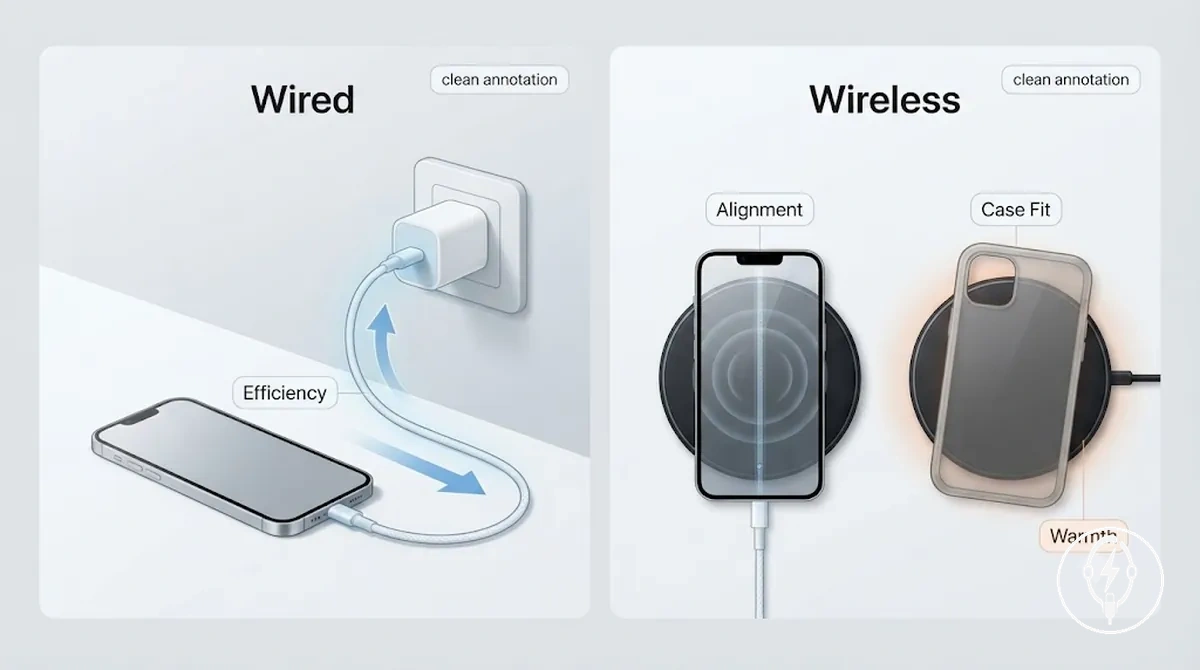
For example, placing an iPhone centrally on a compatible Qi charging pad with a wireless-charging-compatible case allows the charging coils to couple efficiently, whereas a thick or incompatible case or poor alignment can reduce energy transfer and increase charging warmth. According to the Wireless Power Consortium, Qi charging performance depends on coil alignment, and Apple advises removing accessories that interfere with charging if the iPhone charges slowly or becomes warmer than expected. By comparison, wired charging uses direct electrical contact, so cable positioning has less influence on energy transfer once the connector is fully inserted, although damaged cables or incompatible adapters can still reduce charging performance.
A common misconception is that wireless charging is dangerous because the phone becomes warm.
A common misconception is that wireless charging is dangerous because the phone becomes warm. In practice, a moderate amount of warmth can be a normal characteristic of inductive charging, while noticeably greater heat is more likely when alignment is poor, ventilation is restricted, or incompatible accessories interrupt efficient energy transfer. Under normal operating conditions, warmth alone is not evidence of battery damage, so unusual heat should be assessed in the context of the charging setup rather than assumed to indicate a fault.
Understanding these conditions also helps explain broader charging safety tradeoffs without implying that normal charging warmth is itself a safety concern.
Efficiency, Heat, and Energy Loss are easier to compare by evaluating the conditions that affect energy transfer instead of expecting identical behaviour from every charger. Understanding these conditions also helps explain broader charging safety tradeoffs without implying that normal charging warmth is itself a safety concern.
| Condition | Wired effect | Wireless effect | What to watch |
|---|---|---|---|
| Compatible setup | Direct energy transfer with consistent charging efficiency | Efficient energy transfer when charging coils are correctly aligned | Use compatible cables, chargers, charging pads, and cases |
| Misalignment | Usually little effect after the connector is fully inserted | Reduced energy transfer, slower charging, and increased warmth can occur | Reposition the iPhone to improve coil alignment |
| Thick or incompatible case | Usually affects charging only if the connector cannot seat correctly | May interfere with coil alignment and increase charging warmth | Use a wireless-charging-compatible case when charging wirelessly |
Convenience, Cable Wear, and Charging Placement
During daily use at a desk, bedside, in a car, or while travelling, the charging method changes how the iPhone is plugged in, positioned, and accessed while charging. A wired charger requires the charging cable to be connected to the iPhone for every charging session, whereas a charging pad or charging stand allows the phone to be placed on the charging surface without connecting the cable directly to the device. Convenience therefore depends on charging placement, phone accessibility, and whether repeated cable handling or correct wireless alignment better suits the charging location.
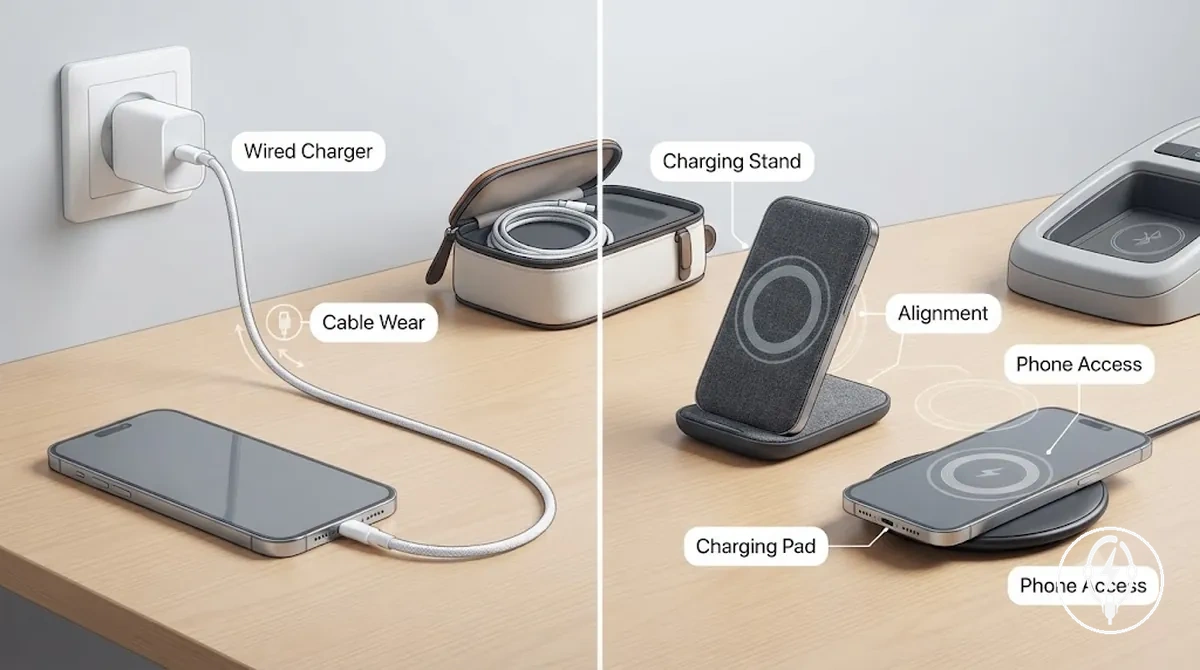
Wired charging provides a continuous physical connection that makes it easy to confirm the iPhone is charging, but repeated plugging and unplugging can increase cable wear and cable strain at the connector over time. Wireless charging reduces repeated connector use because the cable remains attached to the charging pad or charging stand instead of the iPhone, although correct alignment is required whenever the phone is placed on the charger. For example, a bedside charging stand allows the iPhone to be lifted to check notifications and returned to the charger without reconnecting a cable, while a wired charger avoids alignment but requires reconnecting the cable after each use. The practical tradeoff is reduced cable wear versus the need to maintain proper alignment for consistent charging.
The practical tradeoff is reduced cable wear versus the need to maintain proper alignment for consistent charging.
Convenience, Cable Wear, and Charging Placement are easiest to evaluate by comparing the daily handling tasks associated with each charging method. The checklist below organises the main practical differences before the later section compares which charging method suits specific situations.
- Plugging frequency: A wired charger requires connecting the charging cable to the iPhone each time, while a charging pad or charging stand only requires placing the phone in the correct position.
- Phone accessibility: Wireless charging makes it easier to pick up and return the iPhone during desk charging or bedside charging, provided alignment is restored afterwards.
- Cable strain: Frequent cable insertion and removal can increase connector and cable strain, while wireless charging leaves the charging cable connected to the charger rather than the phone.
- Alignment: Wireless charging depends on correct phone placement for charging to continue, whereas wired charging depends on the connector remaining fully inserted.
- Charging location: A wired charger is practical where a cable can remain connected, while charging pads and charging stands provide greater placement flexibility on desks, bedside tables, and other fixed charging locations.
Compatibility Requirements for Cables, Pads, and Magnetic Chargers
Compatibility requirements depend on the complete charging setup rather than on a single accessory. A compatible setup requires the iPhone model, connector, adapter, cable, wireless standard, case fit, and magnetic alignment to work together under the charging method being used. Apple specifies that charging performance begins with using compatible accessories, so compatibility should be verified before evaluating charging speed, safety, or battery-health effects.
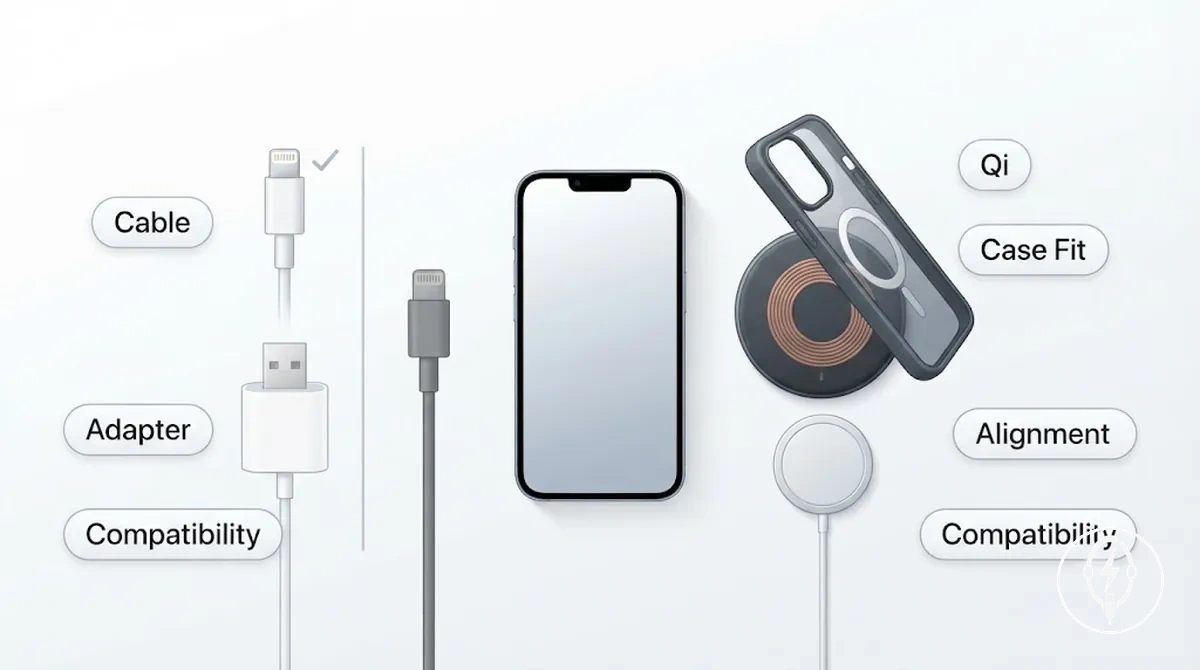
For wired charging, the connector on the cable must match the iPhone charging port, and the cable and power adapter must both support the required charging connection. Apple specifies that iPhone charging requires a compatible cable connected to a compatible USB power source, so a mismatched connector or unsupported adapter can prevent charging or reduce available charging capability. For example, an iPhone with a USB-C connector requires a USB-C charging cable, while an iPhone with a Lightning connector requires a Lightning cable, and the adapter must accept the corresponding cable connection.
For wired charging, the connector on the cable must match the iPhone charging port, and the cable and power adapter must both support the required charging connection.
For wireless charging, the charger must support the Qi wireless charging standard, the iPhone model must support wireless charging, and the case fit must allow reliable coil contact. Apple specifies that MagSafe uses magnetic alignment on supported iPhone models to improve positioning, while the Wireless Power Consortium defines Qi as the interoperable wireless charging standard used by compatible charging pads and stands. If the wireless standard, case fit, or magnetic alignment does not meet these compatibility requirements, the charging setup can charge slowly, misalign, or require another compatible accessory.
Use the checklist below to confirm fit conditions and then choose the right charging accessories .
Compatibility Requirements for Cables, Pads, and Magnetic Chargers can be verified quickly by checking each accessory before assembling the charging setup. Use the checklist below to confirm fit conditions and then choose the right charging accessories.
| Accessory type | Compatibility check | Condition to verify | Possible outcome |
|---|---|---|---|
| Charging cable | Connector type | Matches the iPhone charging port | Charges correctly or requires a compatible cable |
| Power adapter | Cable and power-source support | Accepts the cable connector and provides compatible USB charging output | Charges normally or limits charging capability |
| Wireless charging pad | Wireless standard | Supports Qi and allows correct coil alignment | Charges correctly, charges slowly, or misaligns |
| Magnetic charger | Magnetic alignment and case fit | Supported iPhone model and compatible case permit proper magnetic positioning | Maintains alignment or needs another compatible accessory |
Battery Health Considerations When Comparing Charging Methods
Battery health depends more on heat, charging habits, charging duration, and accessory quality than on whether an iPhone uses wired charging or wireless charging. Apple states that lithium-ion batteries age faster when exposed to elevated temperatures, so battery health considerations should focus on limiting heat exposure and using compatible charging accessories rather than treating the charging method itself as the determining factor. The wired or wireless label therefore has less influence than the conditions under which charging occurs.
The wired or wireless label therefore has less influence than the conditions under which charging occurs.
For example, charging an iPhone for several hours in a hot vehicle or on a poorly aligned wireless charger that generates unnecessary warmth creates greater battery-health concern than using either charging method under normal conditions. According to Apple, iPhone devices are designed to operate and charge in ambient temperatures between 0 °C and 35 °C, while storage temperatures extend from −20 °C to 45 °C; operating outside the recommended charging range can accelerate battery ageing and reduce long-term capacity. In practical terms, controlled heat exposure and sensible charging habits create lower battery-health concern regardless of whether the charging method is wired or wireless.
Battery health considerations should therefore compare charging conditions instead of assuming one charging method is inherently better for the battery.
Battery health considerations should therefore compare charging conditions instead of assuming one charging method is inherently better for the battery. Heat exposure, charging duration, accessory quality, and charging habits provide more meaningful comparison criteria than the charging method alone, while poor-quality adapters, damaged cables, or poorly aligned wireless chargers can increase unnecessary battery stress. For a broader explanation of long-term battery care, see battery health considerations, which examines battery ageing beyond this wired-versus-wireless comparison.
For a broader explanation of long-term battery care, see battery health considerations , which examines battery ageing beyond this wired-versus-wireless comparison.
Battery Health Considerations When Comparing Charging Methods are easiest to assess by reviewing the charging conditions below rather than assuming one method universally protects or harms the battery.
- Heat: Keep charging within Apple's recommended operating range of 0 °C to 35 °C to reduce unnecessary battery stress.
- Charging duration: Avoid leaving the iPhone charging unnecessarily for long periods in high-heat conditions, especially where ventilation is poor.
- Poor alignment: Position the iPhone correctly on compatible wireless chargers to minimise unnecessary warmth caused by inefficient coil alignment.
- Accessory quality: Use compatible Apple-certified or standards-compliant cables, adapters, charging pads, and magnetic chargers that support the iPhone correctly.
- Case fit and unusual warmth: Remove or replace a case that interferes with charging alignment if the iPhone becomes unusually warm during charging, rather than assuming wireless charging itself is responsible.
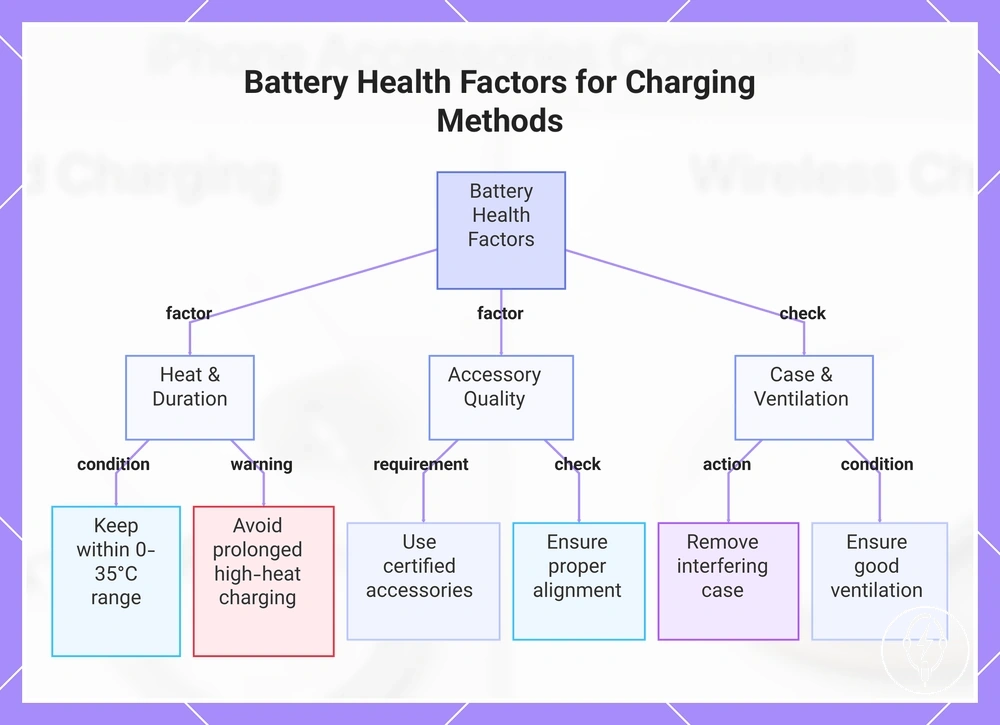
This chart shows the main conditions that affect battery health more than the choice between wired and wireless charging.
Best Charging Method by Situation
The best charging method depends on the situation rather than on a universal preference for wired charging or wireless charging. The practical decision should match the user's speed need, location, portability, phone access, accessory compatibility, and heat tolerance, because those criteria determine whether wired charging, wireless charging, or a mixed setup is the better fit. Apple supports both wired USB charging and Qi or MagSafe wireless charging on compatible iPhone models, so the appropriate method is determined by the charging scenario rather than by a single universally preferred option.
The best charging method depends on the situation rather than on a universal preference for wired charging or wireless charging.
For home, desk, or bedside use, wireless charging is usually the better fit when convenient phone access is the highest priority and the charger, case, and iPhone are compatible. Apple specifies that MagSafe helps align supported iPhone models with compatible chargers, reducing the need to reconnect a cable each time the phone is picked up and returned. For example, checking notifications several times during a workday is more convenient when the phone can simply be placed back onto a correctly aligned charging stand, making convenience the deciding condition rather than maximum charging speed.
For fast top-ups, travel, or backup charging , wired charging is usually the better choice because direct cable connection removes wireless alignment as a charging condition.
For fast top-ups, travel, or backup charging, wired charging is usually the better choice because direct cable connection removes wireless alignment as a charging condition. Apple states that fast charging requires a compatible USB-C power adapter and compatible cable, making wired charging the practical option when the priority is reducing charging time before leaving home or while travelling. A mixed setup is therefore a practical choice when wireless charging suits fixed locations such as a desk or bedside table, while wired charging better supports portability or urgent charging needs.
The table below maps common situations to the most suitable charging method and also shows when both methods are reasonable because the priority changes.
Best Charging Method by Situation is easiest to compare by matching the charging scenario to its main priority instead of assuming one method suits every user. The table below maps common situations to the most suitable charging method and also shows when both methods are reasonable because the priority changes.
| Situation | Main priority | Better fit | Condition to check |
|---|---|---|---|
| Desk or office | Phone access | Wireless charging | Compatible Qi or MagSafe charger with correct alignment |
| Bedside charging | Convenience | Wireless charging | Compatible case and stable charger placement |
| Fast top-up before leaving | Speed need | Wired charging | Compatible cable and USB power adapter that support fast charging |
| Travel or portable charging | Portability | Wired charging | Carry a compatible charging cable and power adapter |
| Daily routine with multiple locations | Convenience and flexibility | Mixed setup | Use wireless charging at fixed locations and wired charging when faster top-ups or portable charging are needed |
Quick Top-Ups and Fast Charging Needs
Wired charging is usually the better choice for quick top-ups and fast charging needs when both the adapter support and cable support meet Apple's fast-charging requirements. Apple specifies that fast charging on supported iPhone models requires a compatible USB-C power adapter with USB Power Delivery (USB-PD) and a compatible USB-C charging cable, enabling the iPhone to negotiate its supported charging power. An underpowered adapter or a cable that does not support the required power delivery results in a more limited top-up during the same charging window, even though the charging session still functions.
- Adapter support: Use a compatible USB-C power adapter that supports USB Power Delivery. Apple states that supported iPhone models can fast charge only when the power source supports the required USB-PD negotiation.
- Cable support: Use a compatible USB-C charging cable capable of carrying USB Power Delivery. A cable that supports charging but not the required power delivery capability can reduce the amount of charge delivered during a short charging window.
- Charging window: During a short charging window, a fast wired charger with compatible adapter support and cable support provides a faster top-up than an underpowered cable-and-plug setup, but Apple does not specify guaranteed charging times because the outcome depends on the iPhone model, battery condition, and charging environment.
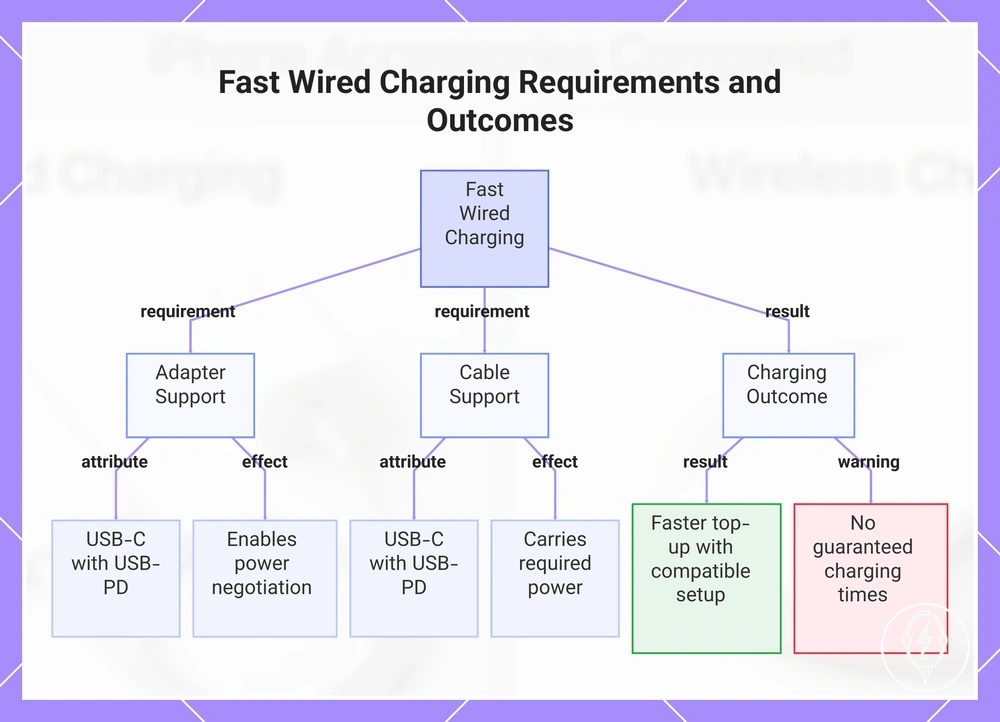
This chart shows the key requirements for fast wired charging on supported iPhones and the expected outcome based on component compatibility.
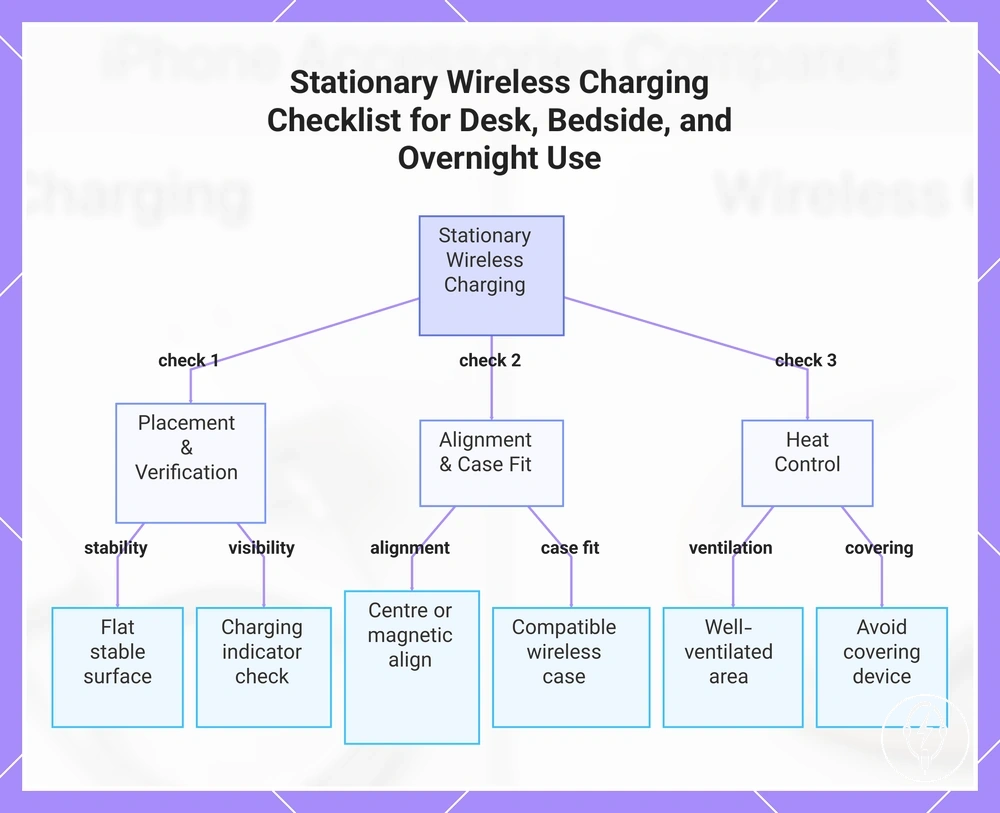
Desk, Bedside, and Overnight Charging
Desk charging, bedside charging, and overnight charging are situations where a wireless pad, wireless stand, or magnetic charger is generally the more convenient choice for stationary charging, provided the iPhone remains correctly aligned and the charging surface is stable. Apple specifies that Qi and MagSafe charging depend on proper alignment for consistent charging, so placement stability, visibility, case fit, and heat control determine whether wireless charging remains convenient during stationary use rather than the charging location alone. :contentReference[oaicite:0]{index=0}
For Desk, Bedside, and Overnight Charging , use the checklist below to verify the placement and visibility conditions before relying on a wireless charging setup.
For Desk, Bedside, and Overnight Charging, use the checklist below to verify the placement and visibility conditions before relying on a wireless charging setup.
- Placement stability: Position the wireless pad or wireless stand on a flat, stable surface so the iPhone remains aligned during charging.
- Visibility: Confirm the charging indicator appears after placing the iPhone so charging has started before leaving the device.
- Alignment and case fit: Centre the iPhone on the wireless pad or allow the magnetic charger to align correctly, and use a case that supports wireless charging.
- Heat control: Keep the charger in a well-ventilated area and avoid covering the iPhone or charger during overnight charging, because Apple states that elevated temperatures can affect battery performance and longevity.
When these conditions are met, wireless charging is convenient for stationary desk or bedside use. Overnight charging should still be treated as conditional on correct placement, compatible accessories, and normal heat control rather than assumed to be risk-free. :contentReference[oaicite:1]{index=1}
When these conditions are met, wireless charging is convenient for stationary desk or bedside use.
This chart groups the essential checks for reliable wireless charging at a desk, bedside, or overnight: placement stability, charging verification, alignment and case compatibility, and heat management.
Travel and Portable Charging Setups
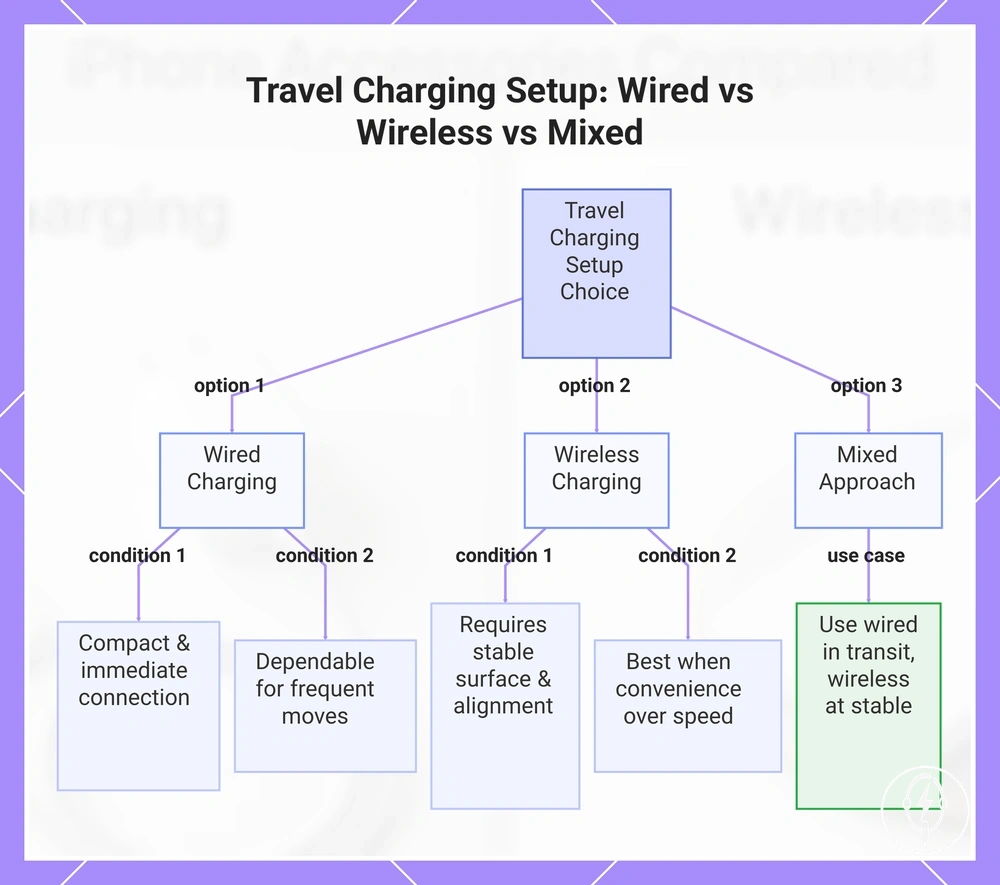
Travel charging and portable charging are usually better suited to wired charging when luggage space is limited, outlet access is uncertain, or dependable charging speed is the priority, while a magnetic charger or charging pad is more suitable when a stable charging surface is available. Apple specifies that both wired USB charging and Qi or MagSafe wireless charging require compatible accessories, while wireless charging also depends on correct alignment for reliable operation. For travel and backup charging, portability and dependability are therefore the primary decision criteria. :contentReference[oaicite:0]{index=0}
For travel and backup charging, portability and dependability are therefore the primary decision criteria.
Travel and Portable Charging Setups should be evaluated against the practical constraints below before choosing a wired, wireless, or mixed charging approach.
- Outlet access: If charging opportunities are short or unpredictable, a cable and plug provide the most dependable setup because charging starts immediately after connection.
- Packing space: A single charging cable and compact plug generally occupy less luggage space than carrying both a charging pad and its attached cable.
- Durability: Wired charging remains dependable when charging locations change frequently because it does not rely on maintaining magnetic or coil alignment.
- Charging speed: Choose wired charging when reducing charging time is the priority, while a magnetic charger or charging pad is better suited to stationary travel locations where convenience outweighs charging speed.
- Setup simplicity: A mixed choice is practical for backup charging when travel conditions are uncertain, using wired charging during transit and a magnetic charger or charging pad where a stable surface is available.
This chart shows the three main charging options for travel and the conditions that favor each.
When Wired, Wireless, or Both Makes More Sense
Wired charging, wireless charging, or both can each be the right practical choice depending on the user's decision criteria rather than a universal recommendation. Apple supports both USB wired charging and Qi or MagSafe wireless charging on compatible iPhone models, so the final decision should be based on speed, convenience, compatibility, heat, portability, and charging location. This recommendation matrix converts the earlier comparison into a practical decision framework for selecting the most suitable charging method. :contentReference[oaicite:0]{index=0}
If speed, portability, and charging reliability are the highest decision criteria, wired charging is the stronger practical choice.
Wired charging is the recommended method when the primary user need is quick top-ups, dependable charging while travelling, or the fastest supported charging speed using a compatible USB-C power adapter and cable. Apple specifies that supported iPhone models can fast charge only when compatible accessories are used, making compatibility a required condition rather than an optional preference. If speed, portability, and charging reliability are the highest decision criteria, wired charging is the stronger practical choice. :contentReference[oaicite:1]{index=1}
Wireless charging is the recommended method when convenience, simple phone placement, and stationary use are more important than the shortest charging time.
Wireless charging is the recommended method when convenience, simple phone placement, and stationary use are more important than the shortest charging time. Apple specifies that Qi and MagSafe charging require compatible accessories and correct alignment, making charger compatibility and stable placement essential conditions for consistent charging. If the charging location is a desk, bedside table, or another fixed location where convenience outweighs speed, wireless charging is the stronger practical choice. :contentReference[oaicite:2]{index=2}
A mixed setup combines wired charging and wireless charging so each method is used where it provides the greatest practical benefit.
A mixed setup combines wired charging and wireless charging so each method is used where it provides the greatest practical benefit. For example, wired charging can be used for commuting, travel, or rapid charging before leaving home, while wireless charging suits desks and bedside tables where convenience is the priority. The final decision is therefore determined by the user's charging location, compatibility, portability, heat management, and daily routine rather than by selecting a single charging method for every situation. :contentReference[oaicite:3]{index=3}
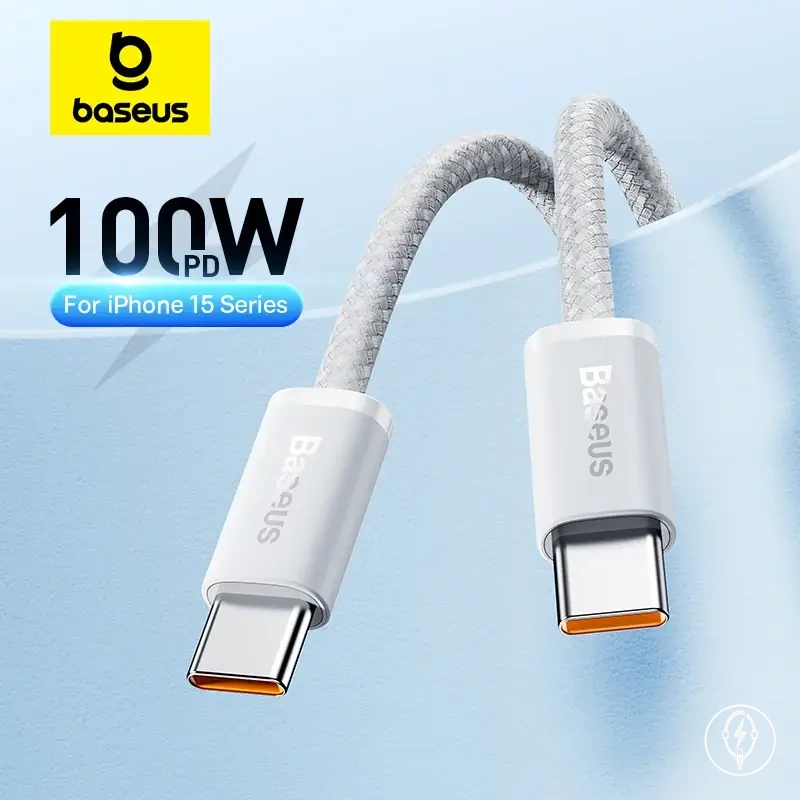
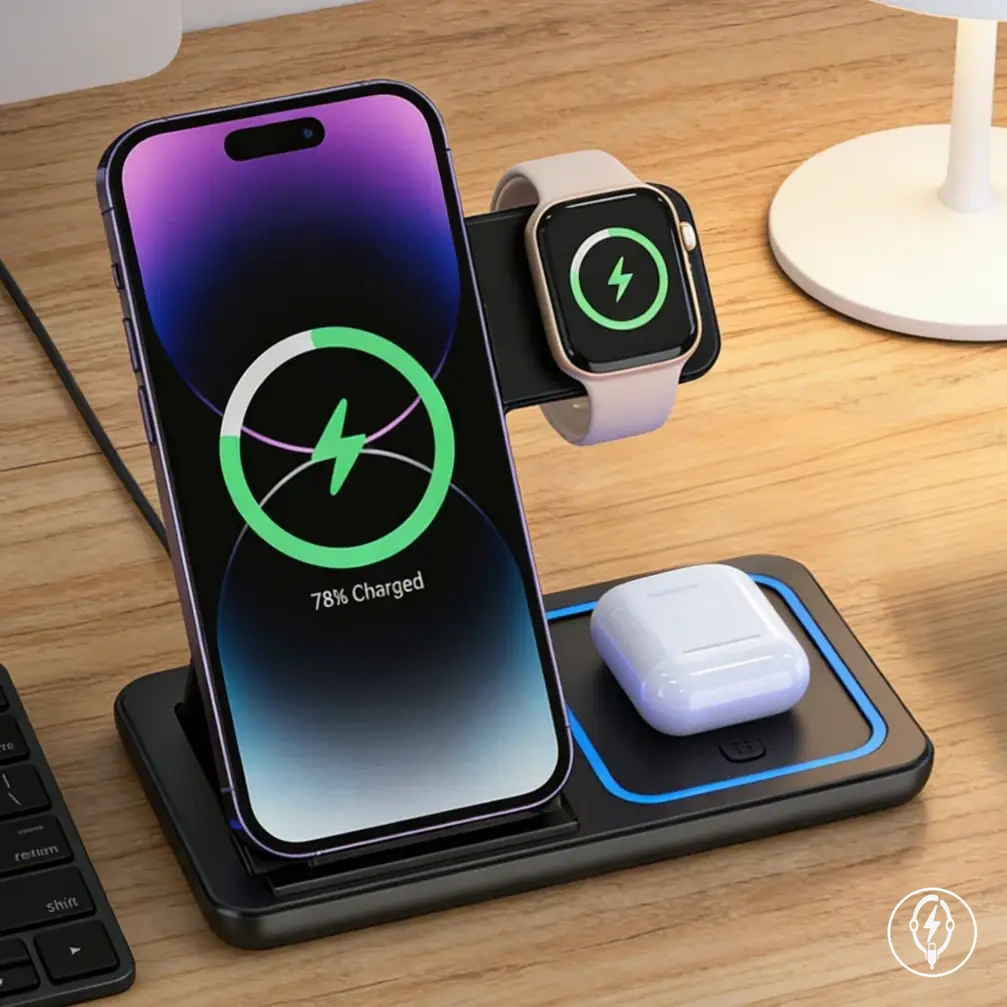
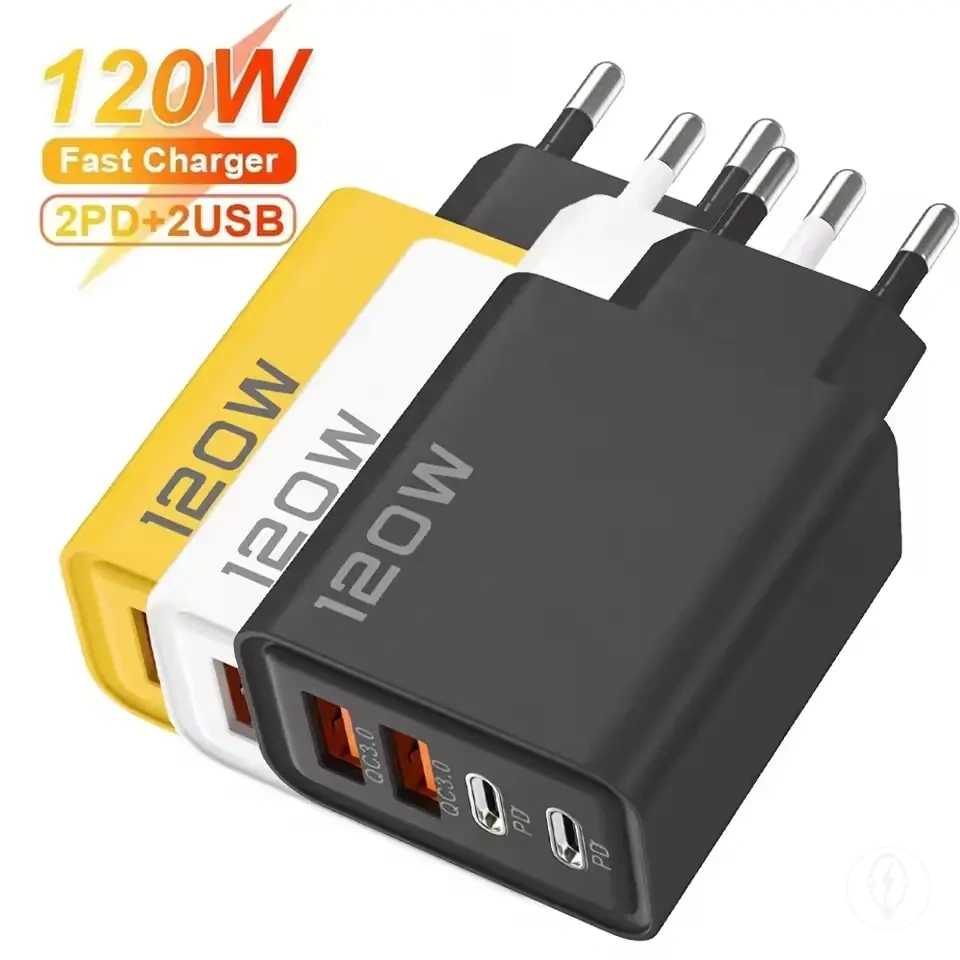
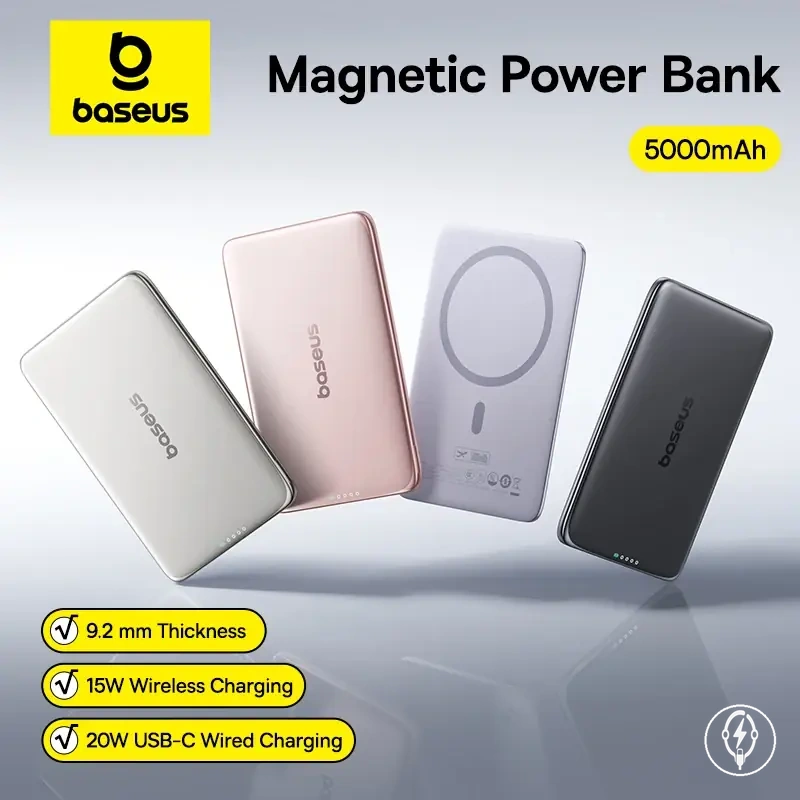
The products below are useful examples for comparing available options.
The products below are useful examples for comparing available options. Before buying, check that the compatibility criteria, key features, and product details match your needs.

| User need | Better method | Required condition | Why it fits |
|---|---|---|---|
| Quick top-ups and maximum supported speed | Wired charging | Compatible USB-C power adapter and charging cable | Prioritises charging speed and a direct electrical connection. |
| Desk or bedside charging | Wireless charging | Compatible Qi or MagSafe charger with correct alignment | Prioritises convenience and easy phone placement during stationary use. |
| Travel and portable charging | Wired charging | Portable cable, compatible adapter, and outlet access | Provides dependable charging without alignment requirements. |
| Daily routine across multiple locations | Both (mixed setup) | Compatible wired and wireless charging accessories | Balances speed, convenience, portability, heat considerations, and charging location. |
Common Questions About Wired and Wireless iPhone Charging
Is wired charging better than wireless charging for iPhone? Wired charging is the better choice when charging speed or short charging sessions are the priority, while wireless charging is the better choice when convenience is the primary requirement. Apple specifies that supported iPhone models can fast charge only with a compatible USB-C power adapter and compatible cable, whereas Qi and MagSafe charging depend on correct alignment for consistent charging. For example, if only 20 minutes are available before leaving home, a compatible fast wired charger is typically the more practical option because it delivers more charge during that limited charging window. :contentReference[oaicite:0]{index=0}
Does wireless charging affect iPhone battery health?
Does wireless charging affect iPhone battery health? Wireless charging does not inherently reduce iPhone battery health, but excessive heat from poor alignment, incompatible accessories, or hot environments can accelerate lithium-ion battery ageing. According to Apple, iPhone devices are designed to operate and charge in ambient temperatures between 0 °C and 35 °C, making heat management more important than choosing wired charging or wireless charging alone. For example, charging within Apple's recommended temperature range using compatible accessories is a more important battery-health factor than the charging method itself. :contentReference[oaicite:1]{index=1}
Choose MagSafe for convenient stationary charging and a cable when reducing charging time is the deciding condition.
Should I use MagSafe or a cable? MagSafe is the better choice when convenient daily charging is the priority, while a cable is the better choice when the fastest supported charging speed is required. Apple specifies that MagSafe uses magnetic alignment on supported iPhone models, whereas fast charging requires a compatible USB-C power adapter with USB Power Delivery and a compatible cable. Choose MagSafe for convenient stationary charging and a cable when reducing charging time is the deciding condition. :contentReference[oaicite:2]{index=2}
For example, hotels, airports, or vehicles may not always provide an ideal surface for a charging pad, making a cable a practical backup.
Can I travel with only a wireless charger? You can travel with only a wireless charger if stable charging surfaces and compatible power are consistently available, but a cable is usually the more dependable travel option. Wireless charging requires correct alignment each time the iPhone is placed on the charger, whereas wired charging begins immediately after a compatible cable is connected. For example, hotels, airports, or vehicles may not always provide an ideal surface for a charging pad, making a cable a practical backup. :contentReference[oaicite:3]{index=3}
Use both methods when your charging needs change between locations or throughout the day.
When should I use both methods? Use both methods when your charging needs change between locations or throughout the day. A mixed setup uses wired charging for travel and quick top-ups while reserving wireless charging for desks or bedside tables where convenience is more important than charging speed. This approach helps balance charging speed, compatibility, portability, heat management, and convenience without relying on a single charging method. :contentReference[oaicite:4]{index=4}
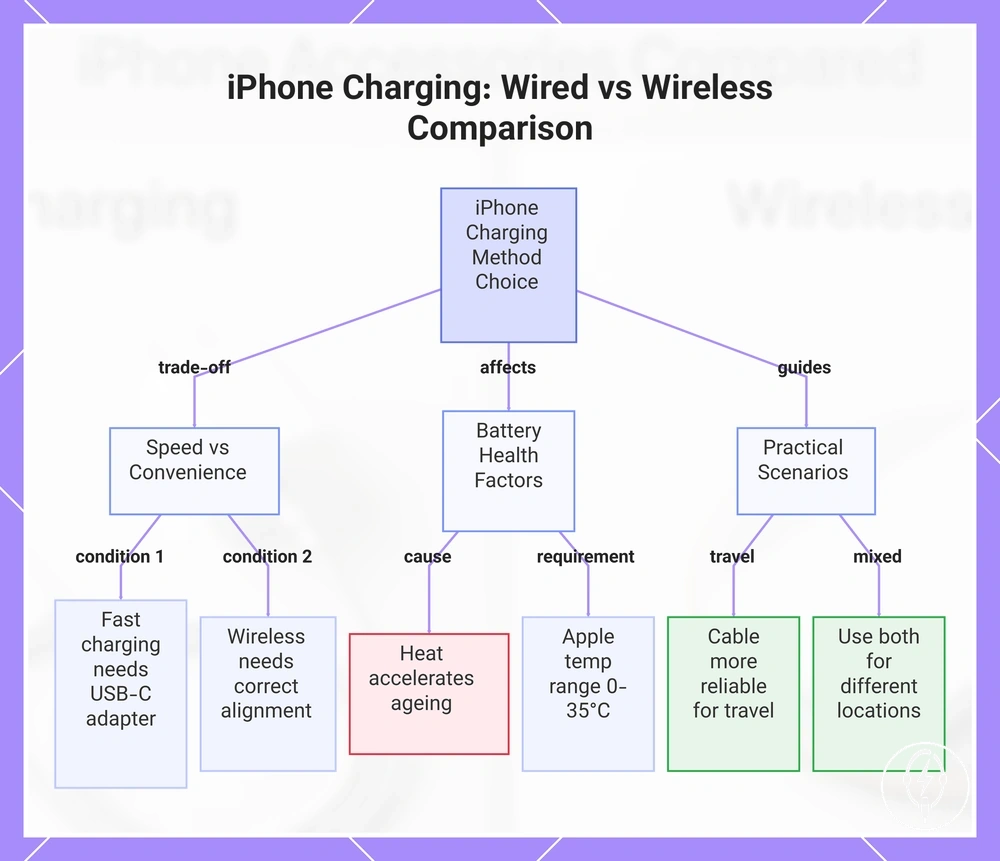
This chart compares wired and wireless iPhone charging across speed, battery health, and practical scenarios to help choose the best method.
This chart compares wired and wireless iPhone charging across speed, battery health, and practical scenarios to help choose the best method.