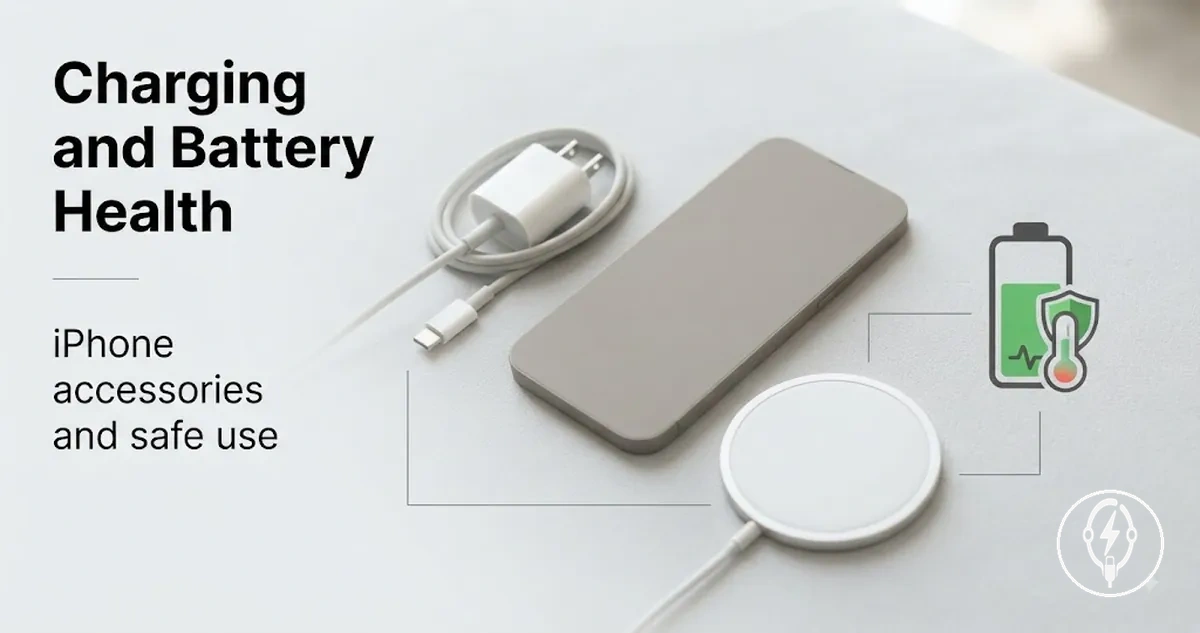
iPhone Charging Accessories and Battery Health
iPhone charging accessories and battery health are directly related because charging accessories influence the conditions under which an iPhone battery charges, not the normal chemical aging of the battery itself. According to Apple, all rechargeable lithium-ion batteries gradually lose capacity as they chemically age, while charging conditions such as heat, stable power delivery, accessory quality, and charging behavior can reduce or increase avoidable battery stress. iPhone charging accessories therefore support battery health by helping maintain appropriate charging conditions rather than preventing normal battery wear. Their influence is conditional, not absolute.
Their influence is conditional, not absolute.
Heat is the primary accessory-related factor that affects battery health. Apple states that iPhone batteries perform best between 16°C and 22°C (62°F to 72°F) and warns that exposure to temperatures above 35°C (95°F) can permanently reduce battery capacity. Proper power delivery, secure cable connections, reliable adapter safety, correct wireless charging alignment, and good cable condition all help minimise unnecessary temperature buildup and charging interruptions. Fast charging and wireless charging are compatible with maintaining battery health when the charging setup keeps heat under control and delivers stable power.
Heat is the primary accessory-related factor that affects battery health.
iPhone charging accessories cannot stop normal lithium-ion battery aging because every rechargeable battery gradually loses maximum capacity through charge cycles and calendar aging. Their practical role is to reduce avoidable battery stress caused by excessive heat, unstable charging, poor wireless alignment, damaged cables, or unreliable adapters. For example, Apple specifies that an iPhone battery is designed to retain up to 80% of its original capacity after 500 complete charge cycles under normal operating conditions, so avoiding unnecessary heat during those cycles helps reduce additional stress without preventing normal aging. This boundary provides the framework for understanding the battery-health guidance throughout the rest of this page.
This boundary provides the framework for understanding the battery-health guidance throughout the rest of this page.
Key principle: iPhone charging accessories support battery health by promoting cooler, more stable charging conditions through appropriate power delivery, cable stability, adapter safety, and charging habits, but no charging accessory can eliminate the normal aging of a lithium-ion battery.
Table of Contents
How Charging Accessories Affect iPhone Battery Health
Charging accessories have an indirect effect on iPhone battery health because they influence charging conditions rather than the battery's chemical aging. According to Apple, lithium-ion batteries naturally lose maximum capacity over time, while charging accessories affect heat, power stability, charging duration, charging consistency, and user behavior during charging. Chargers, cables, adapters, wireless pads, and stands therefore influence the environment in which charging occurs instead of changing the battery chemistry itself. This distinction separates accessory-related charging conditions from the normal aging of the battery.
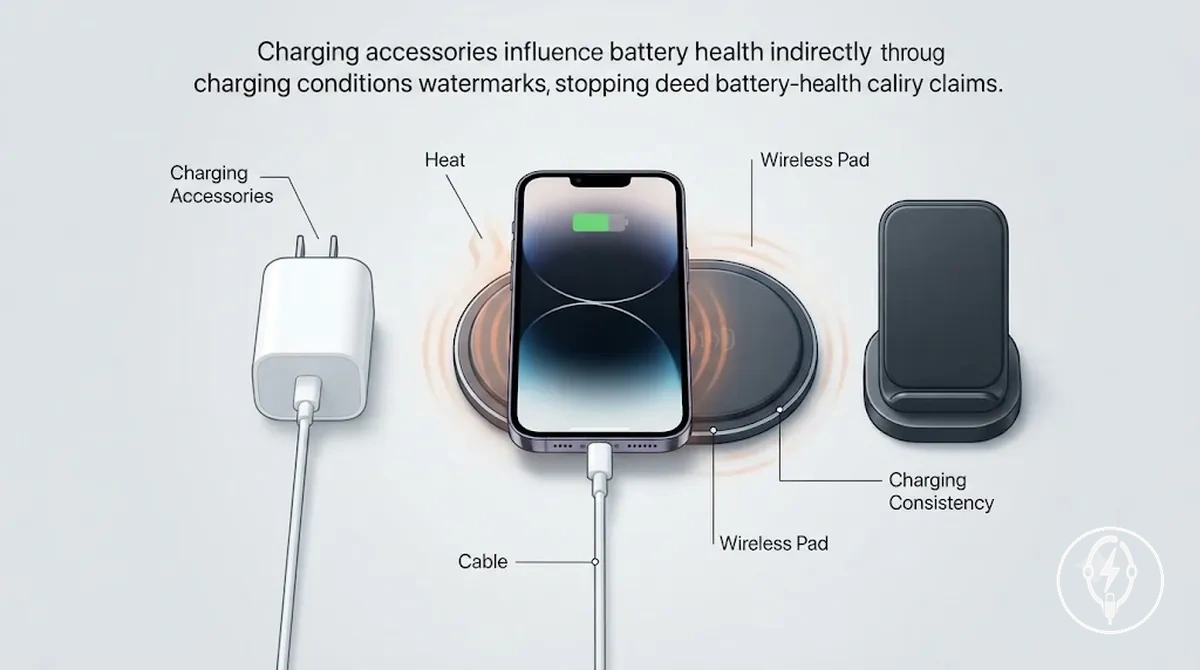
Heat, power stability, and contact consistency are the primary indirect pathways through which charging accessories affect iPhone battery health. Apple states that iPhone batteries perform best between 16 °C and 22 °C (62 °F to 72 °F) and that exposure to temperatures above 35 °C (95 °F) can permanently reduce battery capacity. A stable adapter, an undamaged cable, correct wireless pad alignment, and secure connector contact help maintain consistent current delivery and reduce unnecessary charging interruptions that can increase temperature. For example, if a worn cable disconnects repeatedly during a charging session, the repeated reconnects can extend charging duration and generate more heat than a stable connection.
Heat, power stability, and contact consistency are the primary indirect pathways through which charging accessories affect iPhone battery health.
Charging accessories influence different charging conditions rather than producing the same battery-health outcome:
- Charger and adapter: Help provide stable power delivery that supports consistent charging and reduces unnecessary interruptions.
- Cable: Maintains contact stability and reliable current delivery when the connectors remain undamaged and securely fitted.
- Wireless pad or stand: Correct alignment supports charging consistency and helps minimise unnecessary heat caused by inefficient energy transfer.
Even when appropriate charging accessories are used, Apple states that lithium-ion batteries continue to age through normal charge cycles and calendar aging, so accessories reduce avoidable battery stress rather than prevent battery wear. This distinction provides the correct context for evaluating chargers, cables, adapters, and wireless accessories throughout the iPhone charging accessories hub.
What Accessories Can and Cannot Change About Battery Wear
Accessory choice can influence the charging conditions that contribute to battery wear, but it cannot change the normal chemical aging of an iPhone battery. According to Apple, lithium-ion batteries gradually lose maximum capacity because of charge cycles and calendar aging, while charging accessories primarily affect heat exposure, charging stability, alignment, cable damage, and adapter safety. Accessory choice therefore affects charging conditions rather than battery aging as a whole.
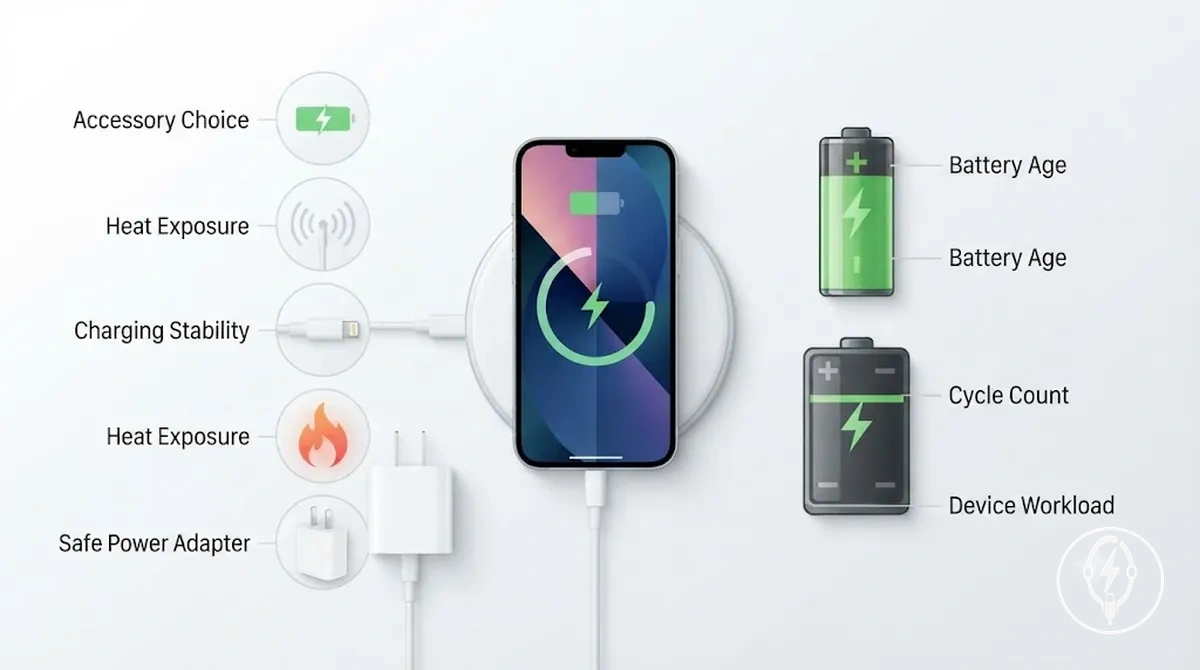
| Accessories Can Influence | Accessories Cannot Control |
|---|---|
| Heat exposure during charging | Battery chemistry |
| Charging stability and charging interruptions | Cycle count |
| Wireless charging alignment | Battery age |
| Cable damage and connector contact quality | App use and device workload |
| Adapter safety and stable power delivery | Normal capacity loss from battery aging |
Accessory-controlled factors mainly affect battery stress during charging. According to Apple, iPhone batteries perform best between 16 °C and 22 °C (62 °F to 72 °F), while prolonged exposure to temperatures above 35 °C (95 °F) can permanently reduce battery capacity. Stable adapters, undamaged cables, and correct wireless charging alignment help reduce unnecessary heat exposure and charging interruptions. For example, replacing a cable with intermittent connector damage can restore charging stability and reduce repeated reconnect cycles, even though the battery's existing capacity remains unchanged.
Accessory-controlled factors mainly affect battery stress during charging.
Accessories cannot reduce cycle count, reverse battery age, or offset battery wear caused by intensive device use. Apple specifies that an iPhone battery is designed to retain up to 80% of its original capacity after 500 complete charge cycles under normal operating conditions, so battery wear continues regardless of charger quality. Activities such as extended gaming, high screen brightness, and sustained processor workloads increase energy consumption and charging frequency independently of accessory choice.
Accessories cannot reduce cycle count, reverse battery age, or offset battery wear caused by intensive device use.
For example, two identical iPhones charged with equally safe accessories may age differently if one device completes 500 charge cycles within two years because of heavier daily use while the other completes substantially fewer cycles during the same period. In that situation, the lower-use device is likely to retain more battery capacity because charging habits and device use, not accessory choice alone, determine long-term battery wear.
Heat as the Main Charging-Related Battery Risk
Heat is the primary charging-related battery risk because elevated temperature increases battery stress even when the charger itself is functioning correctly. According to Apple, iPhone batteries perform best between 16 °C and 22 °C (62 °F to 72 °F), and prolonged exposure to ambient temperatures above 35 °C (95 °F) can permanently reduce battery capacity. Charging accessories influence this risk by affecting heat buildup, ventilation, wireless charging alignment, and charging duration rather than altering battery chemistry. Heat should therefore be managed through the charging environment and accessory setup instead of being treated as an unavoidable problem.
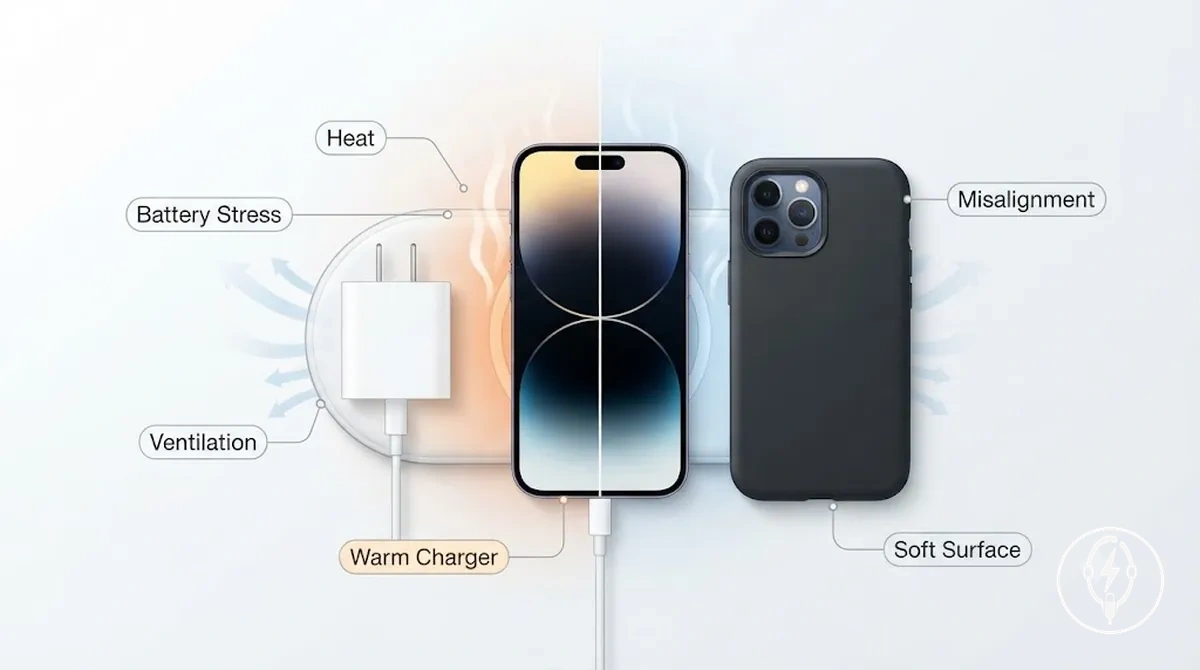
Accessory setup determines how easily charging heat can dissipate. A thick case, poor wireless charging misalignment, a warm charger operating at sustained high power, or charging on a soft surface that restricts ventilation can all create a warmer charging condition and increase battery stress. According to Apple, if an iPhone becomes too warm while charging, the device may limit charging until its temperature decreases to help protect the battery. For example, charging on a hard desk instead of a cushion allows better airflow around the charger and phone, helping heat dissipate more effectively during the charging session.
Accessory setup determines how easily charging heat can dissipate.
Practical warning signs are easier to recognise than measuring battery temperature because Apple does not publish a user-facing charging temperature limit for normal operation. If the phone repeatedly feels unusually warm after charging, the wireless charger frequently loses alignment, the charger remains consistently warm, or a thick case traps heat during charging, improving the charging environment is a sensible next step. Reviewing safe charging accessories can also help reduce repeated heat buildup by improving ventilation, alignment, and overall accessory setup without implying that battery damage has already occurred.
- Charge on a hard surface instead of a soft surface that blocks ventilation.
- Remove a thick case temporarily if it repeatedly causes extra heat during charging.
- Keep the phone correctly aligned on a wireless charging pad throughout the charging session.
- Check whether a warm charger cools normally after charging finishes instead of remaining unusually warm.
- Avoid prolonged charging while running demanding tasks such as gaming or video editing because device use adds extra heat.
- Investigate repeated heat patterns by checking the charger, cable, charging pad alignment, and surrounding ventilation.
Case Thickness, Charging Position, and Heat Buildup
Case thickness, charging position, and airflow can locally increase heat buildup during wired or wireless charging by reducing heat dissipation or charging efficiency. According to Apple, iPhone is designed to operate in ambient temperatures from 0 °C to 35 °C (32 °F to 95 °F), and prolonged exposure to higher temperatures can permanently reduce battery capacity. This local heat condition depends on the combination of case material, charging position, and surrounding airflow rather than on the charging accessory alone.
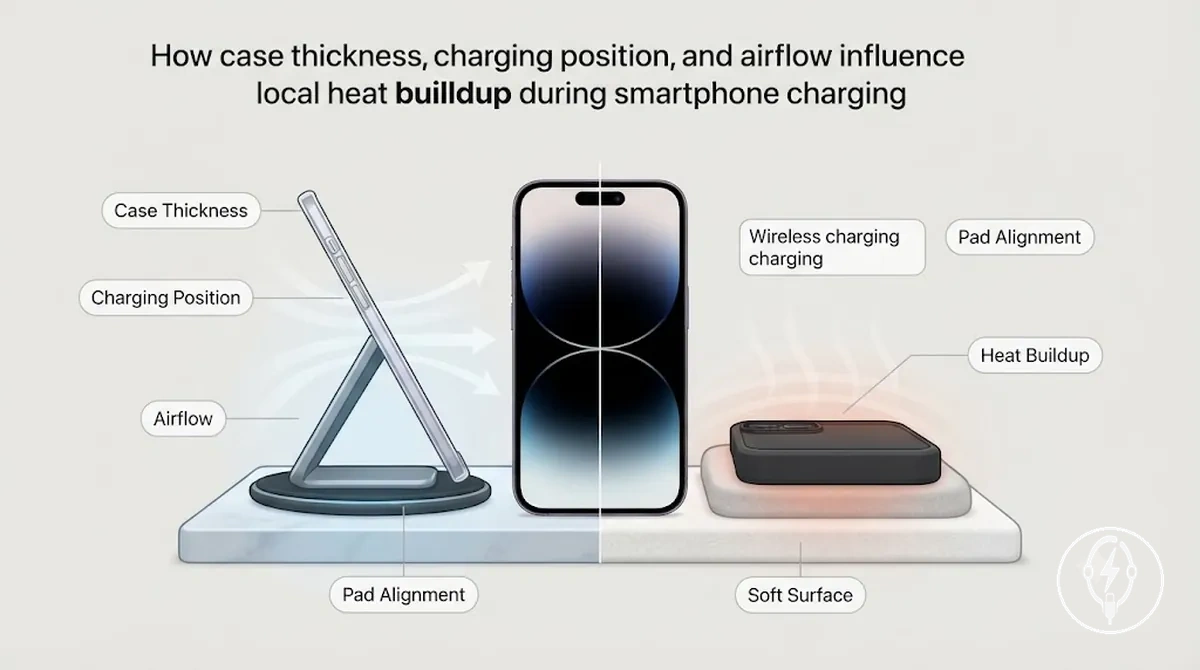
Thicker protective cases, insulating case material, poor wireless pad alignment, an unsuitable stand angle, or charging on a soft surface can all reduce airflow or charging efficiency and keep the phone warmer for longer. Apple notes that if an iPhone becomes too warm while charging, charging may slow or pause until the device cools to help protect the battery. Wireless Power Consortium guidance also recognises that charging efficiency depends on correct coil alignment, so poor pad alignment can increase wasted energy that becomes heat instead of useful charging power.
Apple notes that if an iPhone becomes too warm while charging, charging may slow or pause until the device cools to help protect the battery.
For example, if the same iPhone is charged on a fabric cushion with a thick protective case and the charging coil is slightly misaligned, it can remain warmer than when it is charged on a firm desk with unobstructed airflow and correct pad alignment. This comparison illustrates how charging position and ventilation influence local heat buildup without implying that every thick case or wireless charger creates excessive heat.
This comparison illustrates how charging position and ventilation influence local heat buildup without implying that every thick case or wireless charger creates excessive heat.
Check these local conditions if case thickness, charging position, and heat buildup appear to be related:
- Ensure case thickness does not interfere with normal wired or wireless charging.
- Keep the phone centred on the wireless pad to maintain proper pad alignment.
- Avoid charging on a soft surface that restricts airflow around the phone or charger.
- Use a stable stand angle that leaves ventilation openings unobstructed.
- If the phone repeatedly feels unusually warm, compare one charging session with and one without the protective case to determine whether case material or case thickness contributes to heat trapping.
When Charging Heat Becomes a Battery Health Concern
Charging heat becomes a battery health concern when normal warmth changes into a repeated heat pattern associated with the same charging accessory or charging condition. According to Apple, iPhone may reduce charging speed or temporarily pause charging if the device becomes too warm to help protect the battery, so repeated warmth should prompt a charging setup check rather than a battery failure diagnosis. The important signal is recurring behaviour, not a single warm charging session.
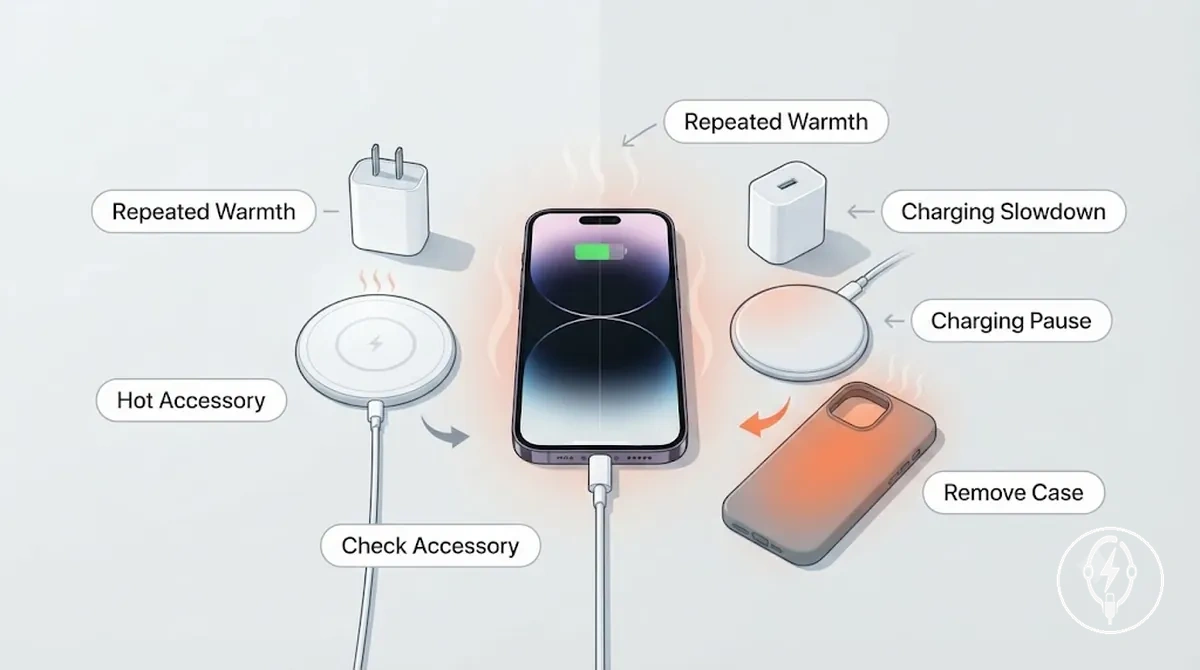
Accessory-specific patterns help identify whether charging heat is related to the charging setup. Apple specifies that iPhone is designed for ambient temperatures between 0 °C and 35 °C (32 °F to 95 °F), and charging may slow or pause when internal temperature rises to protect the battery. For example, if charging slowdown or charging pauses occur only with one cable, adapter, pad, or case under the same room conditions, replacing or repositioning that accessory is a more appropriate next step than assuming the battery is damaged.
- Does repeated warmth occur during multiple charging sessions with the same cable, adapter, pad, or case?
- Does charging slowdown or a temporary charging pause consistently occur with that accessory but not with another one?
- Does one hot accessory become noticeably warmer than a different cable, adapter, or charging pad used under similar conditions?
- Does removing the case or repositioning the phone on the charging pad reduce the recurring heat pattern?
- Does charging heat mainly appear while using the phone for demanding activities such as gaming or video streaming during charging?
If the same accessory repeatedly produces excessive warmth while an alternative accessory under similar conditions does not, pause charging, allow the iPhone to cool naturally, and compare the setup again before drawing conclusions about battery health. This troubleshooting approach helps separate accessory-related charging conditions from normal battery aging without suggesting repair-level action.
Fast Charging and Long-Term Battery Health
Fast charging can support long-term battery health when the iPhone and a compatible charging accessory manage power correctly, while heat and usage context determine whether additional battery stress occurs. According to Apple, compatible iPhone models use USB-C Power Delivery to negotiate charging power with the adapter, and iOS automatically slows or pauses charging if the device becomes too warm to help protect the battery. Fast charging itself is therefore not the primary cause of battery aging; repeated charging at elevated temperatures is the more significant long-term risk.
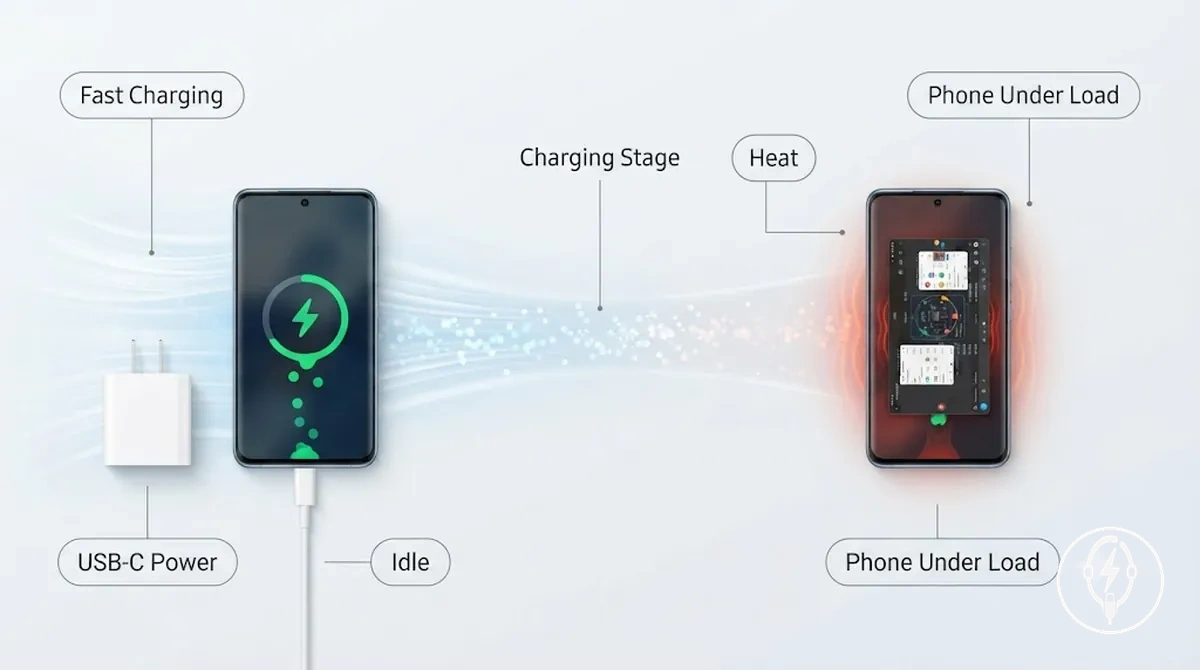
| Charging Use Case | Heat Exposure | Practical Battery Stress |
|---|---|---|
| Occasional fast charging | Controlled when the device remains within normal operating temperature | Typically limited because charging sessions are short and heat remains controlled. |
| Daily top-ups with fast charging | Controlled if the phone is idle and well ventilated | Usually comparable to normal charging when excess heat is avoided. |
| Overnight charging | Reduced by Optimized Battery Charging when supported by charging habits | Designed to minimise time spent at full charge before expected use. |
| Fast charging while the phone is under load | Higher because processor heat combines with charging heat | Greater battery stress than charging the same phone while idle. |
Wattage, USB-C power delivery, adapter quality, and charging stage all influence charging speed without forcing the battery to accept maximum power continuously. Apple specifies that compatible iPhone models can reach up to approximately 50% charge in around 30 minutes when using a 20 W or higher USB-C power adapter under suitable conditions, after which charging current automatically decreases as the battery approaches full capacity. For example, according to Apple, the rapid first charging stage delivers most of the speed benefit, while the slower final stage helps reduce heat and battery stress during the last portion of the charge.
For broader guidance on charging performance, usage patterns, and compatible accessories, see fast charging and battery health .
Daily charging need has a greater influence on long-term battery health than occasional fast charging because usage context changes device temperature during charging. Charging while gaming, navigating, or recording video produces additional processor heat that combines with charging heat, whereas short daily top-ups performed while the phone is idle usually expose the battery to less thermal stress. For broader guidance on charging performance, usage patterns, and compatible accessories, see fast charging and battery health.
Wattage, USB-C Power Delivery, and Safe Charging Speed
Wattage influences the maximum power an adapter can supply, but USB-C Power Delivery determines the safe charging speed by negotiating how much power an iPhone actually accepts. According to Apple, compatible iPhone models can charge to approximately 50% in around 30 minutes when paired with a 20 W or higher USB-C Power Delivery adapter under suitable conditions. The available wattage is therefore negotiated rather than automatically delivered in full throughout the charging session.
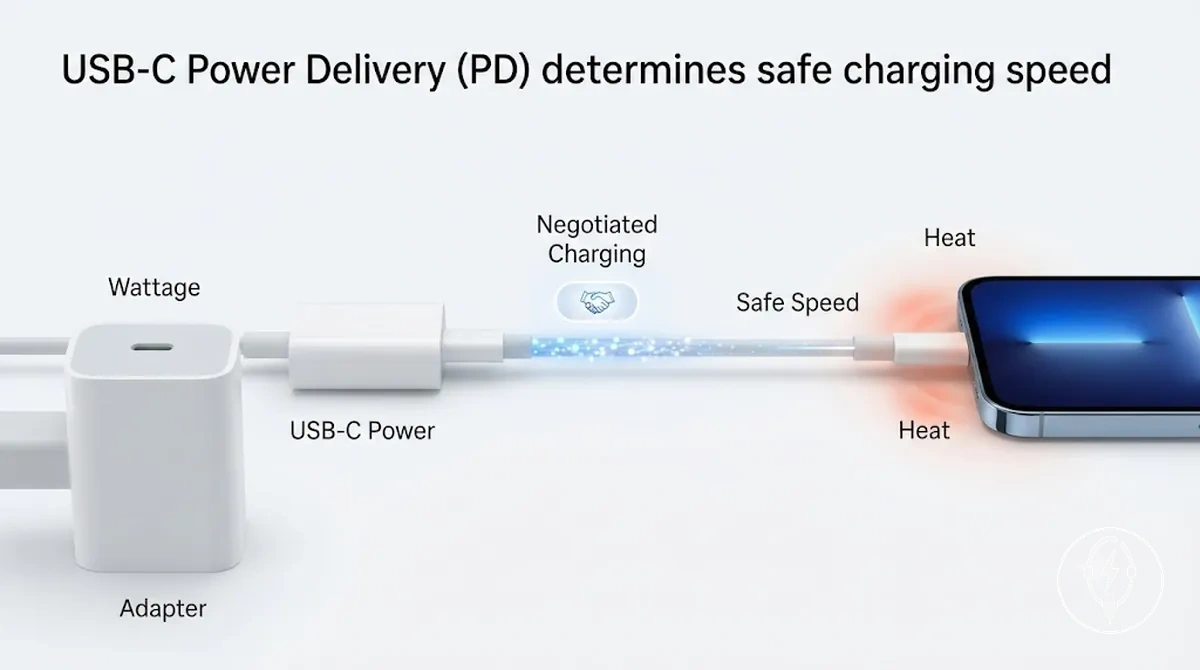
USB-C Power Delivery is an industry-standard charging protocol that allows the iPhone and the adapter to exchange power requirements before charging begins. Apple specifies that the iPhone continuously adjusts negotiated charging according to battery level and device temperature, reducing charging current as the battery approaches full capacity or if additional heat is detected. For example, an iPhone connected to either a 30 W or 65 W USB-C Power Delivery adapter will draw only the power requested by the device under current charging conditions rather than continuously using the adapter's full rated output, producing the same compatibility outcome when higher power is unnecessary.
USB-C Power Delivery is an industry-standard charging protocol that allows the iPhone and the adapter to exchange power requirements before charging begins.
The adapter's rated wattage, protocol support, and iPhone power management work together to determine charging behaviour:
| Adapter Attribute | Charging Behaviour | Compatibility Outcome |
|---|---|---|
| USB-C Power Delivery protocol support | Negotiated charging between the adapter and iPhone | Supports compatible fast charging with managed power delivery. |
| 20 W or higher adapter output (Apple) | Provides sufficient available power for compatible fast charging | Does not mean the iPhone continuously draws the adapter's maximum wattage. |
| Higher battery level or increased temperature | Charging current is automatically reduced by the iPhone | Helps manage charging speed, heat, and long-term battery protection. |
Fast Charging Versus Slower Charging for Daily Use
Fast charging and slower charging are both appropriate for daily use, but the more practical charging pace depends on charging context, heat, charging duration, and convenience rather than one universal rule. According to Apple, compatible iPhones automatically regulate charging power and can reduce or temporarily pause charging if the device becomes too warm, while compatible models can fast charge to approximately 50% in about 30 minutes when used with a 20 W or higher USB-C Power Delivery adapter under suitable conditions. Daily charging needs and heat conditions therefore determine whether fast charging or slower charging is the more suitable choice.
Daily charging needs and heat conditions therefore determine whether fast charging or slower charging is the more suitable choice.
Fast charging is most practical for top-up charging, commuting, and travel because it reduces charging duration when time is limited, whereas slower charging is well suited to overnight use or predictable daily routines where immediate charging speed is unnecessary. For example, according to Apple, reaching approximately 50% charge in around 30 minutes with a compatible 20 W USB-C Power Delivery adapter allows a short charging session before leaving home, while overnight charging gives the iPhone more time to manage charging through features such as Optimized Battery Charging when available. Charging while gaming, video streaming, or navigation increases phone temperature regardless of charging pace, making heat management a more important decision factor than charging speed alone.
| Fast Charging | Slower Charging |
|---|---|
| Suitable for top-up charging when limited time makes shorter charging duration important. | Suitable for overnight use when the phone can remain connected for longer periods. |
| Provides greater convenience during travel, commuting, or busy daily schedules. | Fits regular daily routines where immediate charging speed is unnecessary. |
| Produces the best practical results when the phone remains idle so charging heat stays controlled. | Typically generates less combined heat because charging often occurs while the phone is not actively in use. |
| Less suitable when demanding tasks such as gaming or video streaming are running during charging because processor heat combines with charging heat. | Well suited when the device can remain unused during charging, reducing the combined effect of processor and charging heat. |
Wireless Charging, Alignment, and Battery Temperature
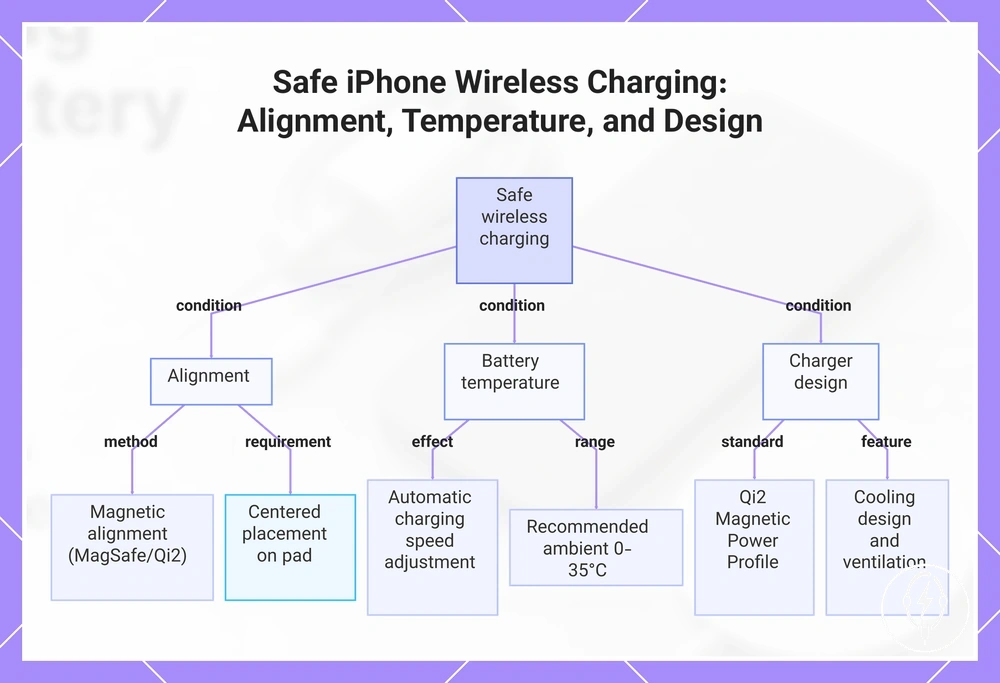
Wireless charging can be safe for iPhone battery health when alignment, battery temperature, and charger design keep heat within normal operating conditions. According to Apple, iPhone automatically manages charging speed and may temporarily slow or pause charging if the battery becomes too warm to help protect it, while the recommended ambient operating temperature is 0 °C to 35 °C (32 °F to 95 °F). Wireless charging therefore depends more on magnetic alignment, case fit, ventilation, and charger design than on the charging method itself, with alignment and heat remaining the primary conditions.
Wireless charging can be safe for iPhone battery health when alignment , battery temperature , and charger design keep heat within normal operating conditions.
A wireless charger, charging pad, or charging stand transfers power through aligned charging coils, making magnetic alignment an important factor for charging efficiency and temperature control. According to the Wireless Power Consortium, Qi2 incorporates a Magnetic Power Profile that improves coil alignment during charging, while Apple specifies that MagSafe-compatible iPhones use magnetic alignment to optimise wireless charging performance. For example, an iPhone correctly centred on a magnetic charging pad with a compatible case can charge more efficiently than the same phone placed several millimetres off-centre or inside an excessively thick case, where reduced coupling can increase temperature buildup and extend charging time.
Practical placement also affects battery temperature during daily charging.
Practical placement also affects battery temperature during daily charging. Charging overnight on a stable charging stand with unobstructed ventilation, a compatible case fit, and a charger designed with appropriate cooling design helps reduce unnecessary heat compared with placing the phone on a soft surface that restricts airflow. For broader guidance on managing wireless charging and heat, compare how charging pads, charging stands, magnetic chargers, and charging surfaces influence battery temperature under everyday conditions.
- Keep magnetic alignment centred on the charging pad or charging stand.
- Use a case fit that does not interfere with wireless charging or magnetic alignment.
- Place the charger on a firm, ventilated charging surface instead of soft materials that retain heat.
- Select a wireless charger with an appropriate cooling design for longer charging sessions.
- If the iPhone repeatedly becomes unusually warm, check alignment, case thickness, charger placement, and surrounding ventilation before assuming a battery problem.
This chart outlines the three essential conditions—alignment, battery temperature, and charger design—that keep iPhone battery safe during wireless charging.
Magnetic Alignment, Charging Stands, and Cooling Design
Magnetic alignment is the positioning of the charging coils in a wireless charger and an iPhone so power transfers efficiently, while charging stands and cooling design influence airflow and temperature during charging. According to the Wireless Power Consortium, the Qi2 standard introduces the Magnetic Power Profile to improve coil placement between compatible devices and chargers, and Apple specifies that MagSafe-compatible iPhones use magnetic alignment to help maintain efficient wireless charging. Better coil placement improves charging efficiency and can reduce unnecessary heat caused by misalignment, but it does not guarantee a lower charging temperature in every setup.
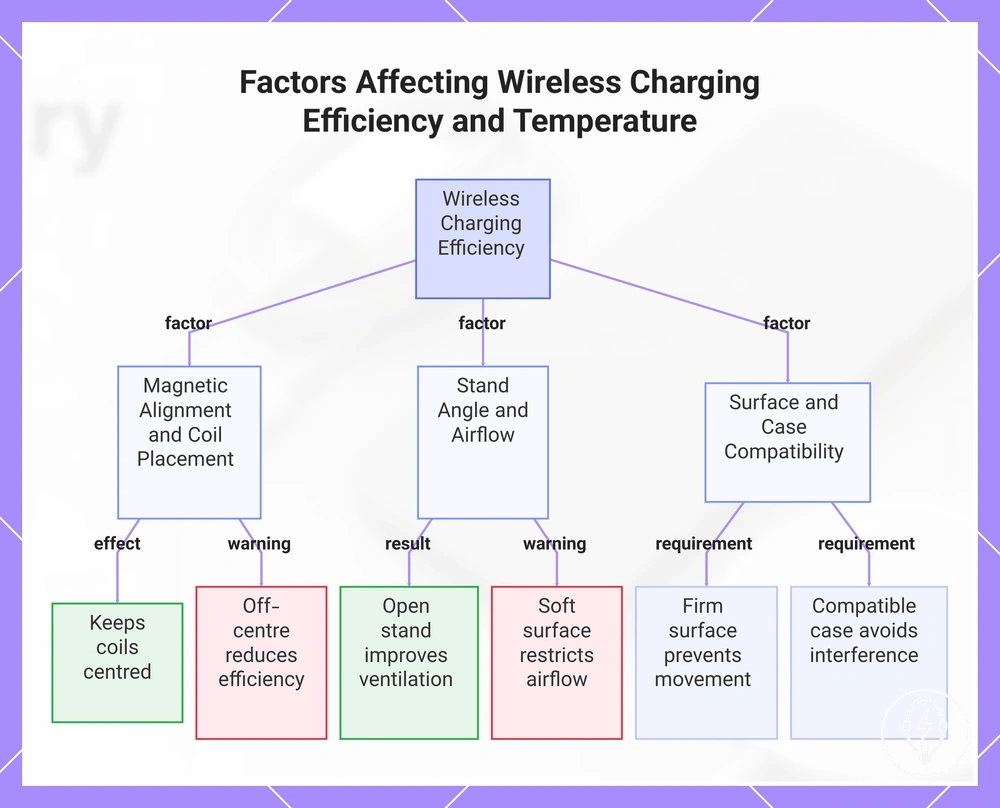
Stand angle , airflow , base material , case compatibility , and surface stability determine how consistently a phone remains aligned and how easily heat dissipates.
Stand angle, airflow, base material, case compatibility, and surface stability determine how consistently a phone remains aligned and how easily heat dissipates. A charging stand that supports stable placement and leaves open space around the device can improve ventilation compared with a soft surface that restricts airflow, while a compatible case helps maintain effective coil placement. For example, according to the Wireless Power Consortium, Qi2 magnetic alignment is designed to improve charging efficiency through more consistent coil positioning, so a phone displaced by approximately 5 mm because of an unstable surface or an excessively thick case is more likely to lose alignment than one that remains centred, increasing the likelihood of reduced charging efficiency and additional heat.
When comparing charging pads, charging stands, and magnetic mounts, these local design attributes have the greatest effect on charging consistency:
- Magnetic alignment: Keeps charging coils centred to improve charging efficiency and reduce heat created by inefficient energy transfer.
- Coil placement: Correct positioning maintains consistent wireless power transfer, while off-centre placement reduces charging efficiency.
- Stand angle and airflow: An open stand design can improve ventilation around the phone compared with a position that blocks airflow.
- Base material and surface stability: A firm, stable surface helps prevent movement that can interrupt alignment during charging.
- Case compatibility: A wireless charging-compatible case is less likely to interfere with magnetic alignment than an excessively thick or poorly fitting case.
This chart outlines the main factors that influence wireless charging efficiency and temperature, including magnetic alignment, stand design, and surface stability.
Wired and Wireless Charging Differences for Battery Stress
Wired charging and wireless charging can both maintain good iPhone battery health when battery stress is controlled through appropriate temperature, charging speed, and charging stability. According to Apple, iPhone automatically regulates charging current and may reduce or temporarily pause charging if the device becomes too warm, so neither charging method is inherently safer than the other. The primary determinant of battery stress is how effectively each charging setup limits unnecessary heat and maintains stable power delivery.
For a broader comparison of charging methods beyond battery health, see wired or wireless battery impact .
Wired charging relies on a stable cable and compatible adapter to deliver consistent power, while wireless charging depends on accurate alignment between charging coils to maximise charging efficiency. Apple specifies that compatible iPhone models can reach approximately 50% charge in around 30 minutes with a 20 W or higher USB-C Power Delivery adapter under suitable conditions, whereas the Wireless Power Consortium states that Qi2 improves magnetic alignment to increase charging efficiency. For example, an iPhone connected to a compatible 20 W USB-C adapter can achieve Apple's quoted fast-charging performance when the cable connection remains stable, while a correctly aligned Qi2 or MagSafe-compatible charger reduces unnecessary energy loss that would otherwise increase charging heat. For a broader comparison of charging methods beyond battery health, see wired or wireless battery impact.
| Battery Stress Condition | Wired Charging | Wireless Charging |
|---|---|---|
| Charging stability | Depends on a secure cable connection and a compatible adapter. | Depends on accurate coil alignment between the phone and charging pad. |
| Temperature management | Heat is primarily influenced by charging power, cable quality, and phone workload. | Heat is more sensitive to alignment, charging efficiency, case thickness, and ventilation. |
| Charging speed | Compatible iPhone models can reach about 50% charge in approximately 30 minutes with a 20 W or higher USB-C Power Delivery adapter, according to Apple. | Charging speed depends on the supported wireless charging standard and correct magnetic alignment. |
| Battery stress | Remains controlled when charging is stable and unnecessary heat is minimised. | Remains comparable when alignment, charging efficiency, and temperature are consistently managed. |
| Use-case fit | Suitable for faster top-up charging and reliable cable-based power delivery. | Suitable for convenient desk or overnight charging when alignment remains consistent. |
Battery-Friendly Charger and Cable Characteristics
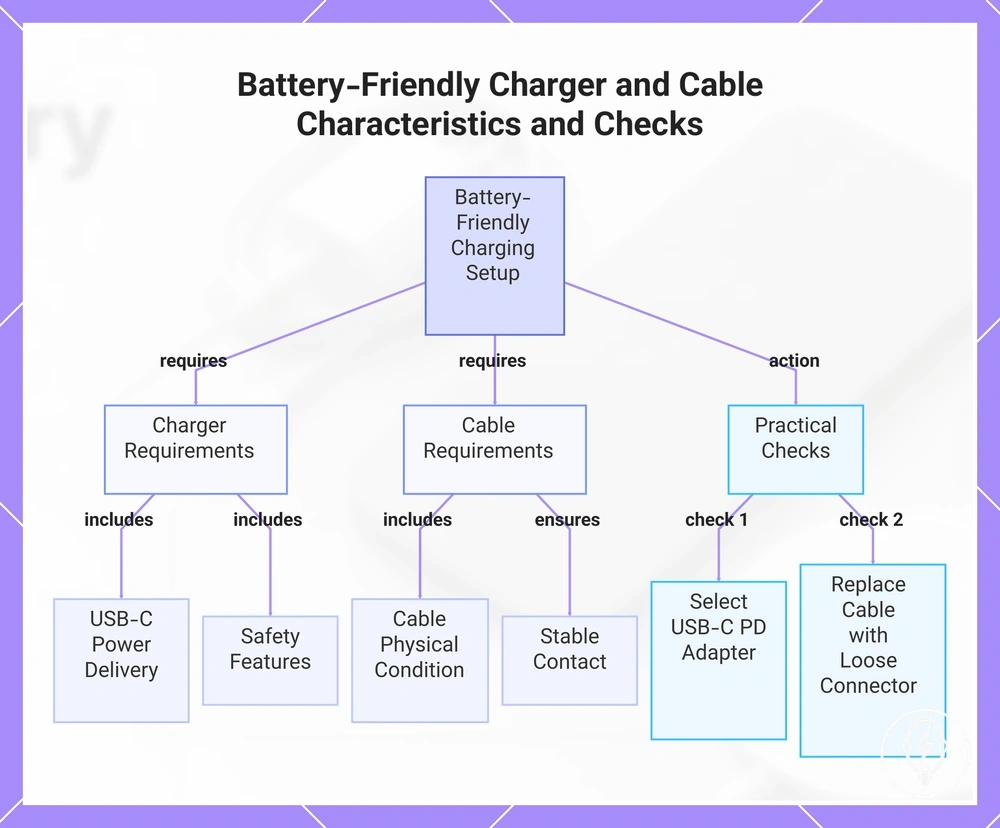
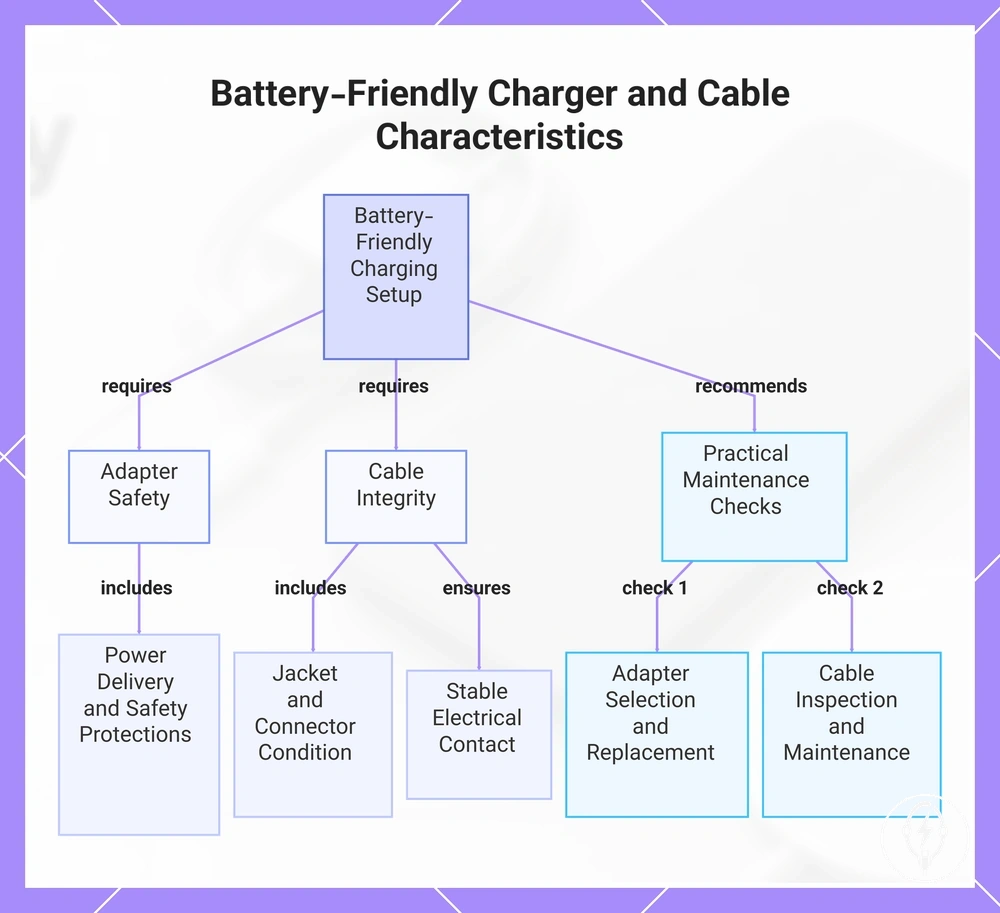
A battery-friendly charger supports safe, stable charging by providing compatible power delivery behavior, effective adapter safety, and controlled charging temperature rather than by preserving battery health on its own. According to Apple, compatible iPhone models negotiate charging power through USB-C Power Delivery and may automatically reduce or pause charging if the battery becomes too warm. Choosing charger and cable characteristics that minimise unnecessary heat and maintain stable charging reduces battery stress but does not prevent normal battery ageing.
Choosing charger and cable characteristics that minimise unnecessary heat and maintain stable charging reduces battery stress but does not prevent normal battery ageing.
Adapter safety depends on compliance with recognised charging standards, stable voltage regulation, and protection features such as over-current, over-voltage, over-temperature, and short-circuit protection. According to USB Implementers Forum, USB Power Delivery negotiates charging power between the charger and the device instead of continuously supplying maximum output, while Apple specifies that compatible iPhone models can reach approximately 50% charge in around 30 minutes when used with a 20 W or higher USB-C Power Delivery adapter under suitable conditions. For example, a compatible 20 W USB-C Power Delivery adapter allows the iPhone to request only the power needed under current battery and temperature conditions, helping reduce unnecessary heat compared with an unstable or incompatible charging setup.
Cable characteristics influence charging stability through cable jacket durability , connector condition , and stable contact .
Cable characteristics influence charging stability through cable jacket durability, connector condition, and stable contact. Physical wear such as cracked insulation, loose connectors, bent contacts, or intermittent cable movement can interrupt charging and increase resistance at the connection point, which may contribute to additional heat during charging. For example, replacing a cable with visible connector wear or damaged insulation restores consistent electrical contact, reducing charging interruptions and helping maintain stable charging conditions rather than improving battery capacity itself.
- Choose an adapter that supports USB-C Power Delivery for compatible negotiated charging.
- Check that the charger includes recognised safety signals such as over-current, over-voltage, over-temperature, and short-circuit protection.
- Replace a charger if it repeatedly becomes unusually hot, produces intermittent charging, or shows visible physical damage.
- Inspect cable jacket durability for cracks, splits, or exposed conductors before continued use.
- Replace a cable if the connector condition causes loose fitting, charging interruptions, or unstable contact.
- Keep charging connectors clean and securely connected to maintain stable contact and reduce unnecessary charging heat.
This chart shows the key requirements for a battery-friendly charging setup, including adapter safety, cable integrity, and practical maintenance checks to reduce heat and maintain stable charging.
Adapter Safety, Protection Features, and Temperature Control
Adapter safety is the combination of protection features, power regulation, temperature control, and build quality that helps a USB-C adapter deliver stable charging while reducing unnecessary heat risk. According to Apple, iPhone 12 and later support fast charging with a USB-C power adapter that provides at least 20 W of power, and stable power regulation is more important for battery-friendly charging than using a higher-wattage adapter. This combination helps maintain stable charging conditions while limiting unnecessary heat during normal operation.
This combination helps maintain stable charging conditions while limiting unnecessary heat during normal operation.
Protection features reduce the likelihood of unsafe charging conditions, while temperature control and build quality help maintain consistent charging behaviour over repeated use. According to Apple, warmth during charging is normal because power conversion generates heat, but persistent excessive heat, repeated charging interruptions, or visible adapter damage are signs to stop using the adapter and replace it. Using safe charging accessories helps reduce avoidable heat risk caused by poor-quality or damaged charging equipment. For example, an iPhone connected to a compliant 20 W USB-C adapter under normal indoor conditions should charge without repeated thermal interruptions, whereas an unstable adapter that repeatedly overheats can slow charging as the iPhone automatically limits charging speed to manage temperature.
Using safe charging accessories helps reduce avoidable heat risk caused by poor-quality or damaged charging equipment.
The most useful adapter safety characteristics include:
- Power regulation: Consistent USB-C Power Delivery output helps maintain stable charging and reduces voltage instability during charging sessions. Apple specifies a minimum 20 W USB-C adapter for supported iPhone fast charging.
- Protection features: Overcurrent, overvoltage, short-circuit, and over-temperature protection are designed to interrupt unsafe electrical conditions instead of allowing uncontrolled heat buildup.
- Temperature control: Effective thermal behaviour allows normal operating warmth while reducing prolonged excessive heat that may trigger slower charging or charging pauses.
- Build quality: Reliable internal components, secure electrical isolation, and durable construction help maintain consistent charging behaviour and reduce long-term heat-related instability.
Cable Condition, Jacket Durability, and Stable Charging
Cable condition is a key attribute for stable charging because physical wear can interrupt the electrical connection between an iPhone and its power source. According to Apple, charging cables with visible damage or exposed internal wiring should no longer be used, as damaged accessories can affect charging reliability and safety. A cable with an intact jacket, secure connector fit, and no visible damage is more likely to maintain stable charging without unnecessary interruptions.
Visible and functional symptoms help determine when a cable should stop being used for battery-safe charging.
Visible and functional symptoms help determine when a cable should stop being used for battery-safe charging. Fraying, connector looseness, intermittent charging, repeated charging interruptions, or unusual heat at the connector indicate a likely cable fault rather than normal charging behaviour. For example, if the same cable disconnects repeatedly while charging one iPhone with two different power adapters, the repeated interruptions indicate an unstable cable connection rather than an adapter problem, consistent with Apple's recommendation to discontinue using damaged charging accessories.
Inspection checklist: Check these cable condition and jacket durability signals before continuing regular charging.
Inspection checklist: Check these cable condition and jacket durability signals before continuing regular charging.
- Fraying: Stop using the cable if the jacket is torn or internal conductors are visible.
- Connector fit: A loose connector that repeatedly loses contact indicates unstable electrical connection.
- Intermittent charging: Repeated charging interruptions during normal use are a practical stop-use signal for battery-safe charging.
- Heat at the connector: If the connector becomes unusually warm while the cable is carrying a normal charging load, discontinue use and inspect the cable.
- Bent ends: Bent connector housings or damaged strain relief increase the likelihood of unstable contact and charging interruptions.
Battery-Friendly Charger and Cable Characteristics
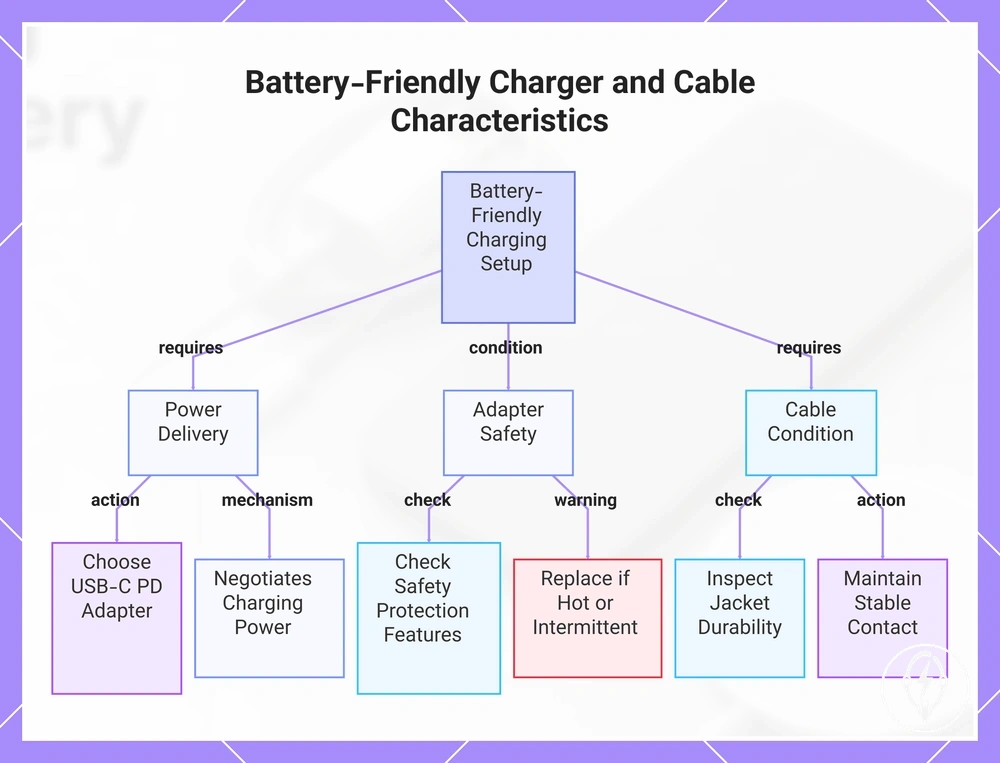
A battery-friendly charger supports safe, stable charging by providing compatible power delivery behavior, effective adapter safety, and controlled charging temperature rather than by preserving battery health on its own. According to Apple, compatible iPhone models negotiate charging power through USB-C Power Delivery and may automatically reduce or pause charging if the battery becomes too warm. Choosing charger and cable characteristics that minimise unnecessary heat and maintain stable charging reduces battery stress but does not prevent normal battery ageing.
According to Apple, compatible iPhone models negotiate charging power through USB-C Power Delivery and may automatically reduce or pause charging if the battery becomes too warm.
Adapter safety depends on compliance with recognised charging standards, stable voltage regulation, and protection features such as over-current, over-voltage, over-temperature, and short-circuit protection. According to USB Implementers Forum, USB Power Delivery negotiates charging power between the charger and the device instead of continuously supplying maximum output, while Apple specifies that compatible iPhone models can reach approximately 50% charge in around 30 minutes when used with a 20 W or higher USB-C Power Delivery adapter under suitable conditions. For example, a compatible 20 W USB-C Power Delivery adapter allows the iPhone to request only the power needed under current battery and temperature conditions, helping reduce unnecessary heat compared with an unstable or incompatible charging setup.
Adapter safety depends on compliance with recognised charging standards, stable voltage regulation, and protection features such as over-current, over-voltage, over-temperature, and short-circuit protection.
Cable characteristics influence charging stability through cable jacket durability, connector condition, and stable contact. Physical wear such as cracked insulation, loose connectors, bent contacts, or intermittent cable movement can interrupt charging and increase resistance at the connection point, which may contribute to additional heat during charging. For example, replacing a cable with visible connector wear or damaged insulation restores consistent electrical contact, reducing charging interruptions and helping maintain stable charging conditions rather than improving battery capacity itself.
- Choose an adapter that supports USB-C Power Delivery for compatible negotiated charging.
- Check that the charger includes recognised safety signals such as over-current, over-voltage, over-temperature, and short-circuit protection.
- Replace a charger if it repeatedly becomes unusually hot, produces intermittent charging, or shows visible physical damage.
- Inspect cable jacket durability for cracks, splits, or exposed conductors before continued use.
- Replace a cable if the connector condition causes loose fitting, charging interruptions, or unstable contact.
- Keep charging connectors clean and securely connected to maintain stable contact and reduce unnecessary charging heat.
This chart shows the key characteristics and practical checks for a battery-friendly charging setup, including power delivery, adapter safety, and cable condition.
Charge Limits, 80 Percent Charging, and Daily Battery Needs
Charge limits are a conditional charging habit that lets compatible iPhone models stop charging at a selected maximum level. According to Apple, supported iPhone models allow a charge limit from 80% to 100% in 5% increments, so 80 percent charging can reduce the time the battery spends at a full state of charge for users whose daily battery needs do not require a full charge, while charging to 100% remains appropriate when additional runtime is needed.
Daily battery needs should determine whether partial charging or a full charge is the better choice.
Daily battery needs should determine whether partial charging or a full charge is the better choice. For example, a user who normally finishes the day with about 20% battery remaining after charging to 80% may not benefit from charging to 100%, whereas someone preparing for travel days or extended periods away from a charger may reasonably choose a full charge for longer runtime. Apple also states that iPhone can occasionally charge beyond the selected charge limit to maintain accurate battery state-of-charge estimates, making charge limits a flexible usage setting rather than a strict rule.
Decision checklist: Choose a charge limit based on these daily-use conditions.
Decision checklist: Choose a charge limit based on these daily-use conditions.
- Daily runtime: If an 80% charge consistently lasts until the end of your normal day, partial charging may fit your battery routine.
- Travel days: Select a full charge when you expect longer periods without access to charging.
- Overnight pattern: An overnight routine can work with either an 80% charge limit or a full charge, depending on the runtime you need the next day.
- Battery age: If battery capacity has declined and daily runtime is no longer sufficient, a full charge may provide more practical benefit than maintaining a lower charge limit.
- User convenience: Choose the charge percentage that reliably supports your daily battery needs instead of treating 80 percent charging as a universal requirement.
Optimized Battery Charging and iPhone Charging Patterns
Optimized Battery Charging is an iPhone battery management feature that learns your iPhone charging patterns and adjusts charging timing to reduce the time the battery spends at a high charge level. According to Apple, the feature typically pauses charging at around 80% and uses delayed final charging to complete charging closer to when the iPhone predicts it will be disconnected, helping reduce battery stress caused by prolonged time at a high charge.
For example, if your iPhone is usually connected to the same charger overnight and unplugged at 7:00 a.m.
According to Apple, Optimized Battery Charging learns charging routines over time and works most effectively when your iPhone follows consistent charging patterns, such as regular overnight charging in familiar locations. For example, if your iPhone is usually connected to the same charger overnight and unplugged at 7:00 a.m., the feature may hold the battery near 80% before completing the remaining charge shortly before that time. This charging routine supports battery management through charging timing, but it does not replace safe accessory use or good heat control during charging.
Battery-Friendly Charger and Cable Characteristics
A battery-friendly charger supports safe, stable charging by providing compatible power delivery behavior, effective adapter safety, and controlled charging temperature rather than by preserving battery health on its own. According to Apple, compatible iPhone models negotiate charging power through USB-C Power Delivery and may automatically reduce or pause charging if the battery becomes too warm. Choosing charger and cable characteristics that minimise unnecessary heat and maintain stable charging reduces battery stress but does not prevent normal battery ageing.
Adapter safety depends on compliance with recognised charging standards, stable voltage regulation, and protection features such as over-current, over-voltage, over-temperature, and short-circuit protection. According to USB Implementers Forum, USB Power Delivery negotiates charging power between the charger and the device instead of continuously supplying maximum output, while Apple specifies that compatible iPhone models can reach approximately 50% charge in around 30 minutes when used with a 20 W or higher USB-C Power Delivery adapter under suitable conditions. For example, a compatible 20 W USB-C Power Delivery adapter allows the iPhone to request only the power needed under current battery and temperature conditions, helping reduce unnecessary heat compared with an unstable or incompatible charging setup.
Cable characteristics influence charging stability through cable jacket durability, connector condition, and stable contact. Physical wear such as cracked insulation, loose connectors, bent contacts, or intermittent cable movement can interrupt charging and increase resistance at the connection point, which may contribute to additional heat during charging. For example, replacing a cable with visible connector wear or damaged insulation restores consistent electrical contact, reducing charging interruptions and helping maintain stable charging conditions rather than improving battery capacity itself.
- Choose an adapter that supports USB-C Power Delivery for compatible negotiated charging.
- Check that the charger includes recognised safety signals such as over-current, over-voltage, over-temperature, and short-circuit protection.
- Replace a charger if it repeatedly becomes unusually hot, produces intermittent charging, or shows visible physical damage.
- Inspect cable jacket durability for cracks, splits, or exposed conductors before continued use.
- Replace a cable if the connector condition causes loose fitting, charging interruptions, or unstable contact.
- Keep charging connectors clean and securely connected to maintain stable contact and reduce unnecessary charging heat.
This chart shows the key requirements for a battery-friendly charging setup and the practical checks to maintain safe, stable charging.